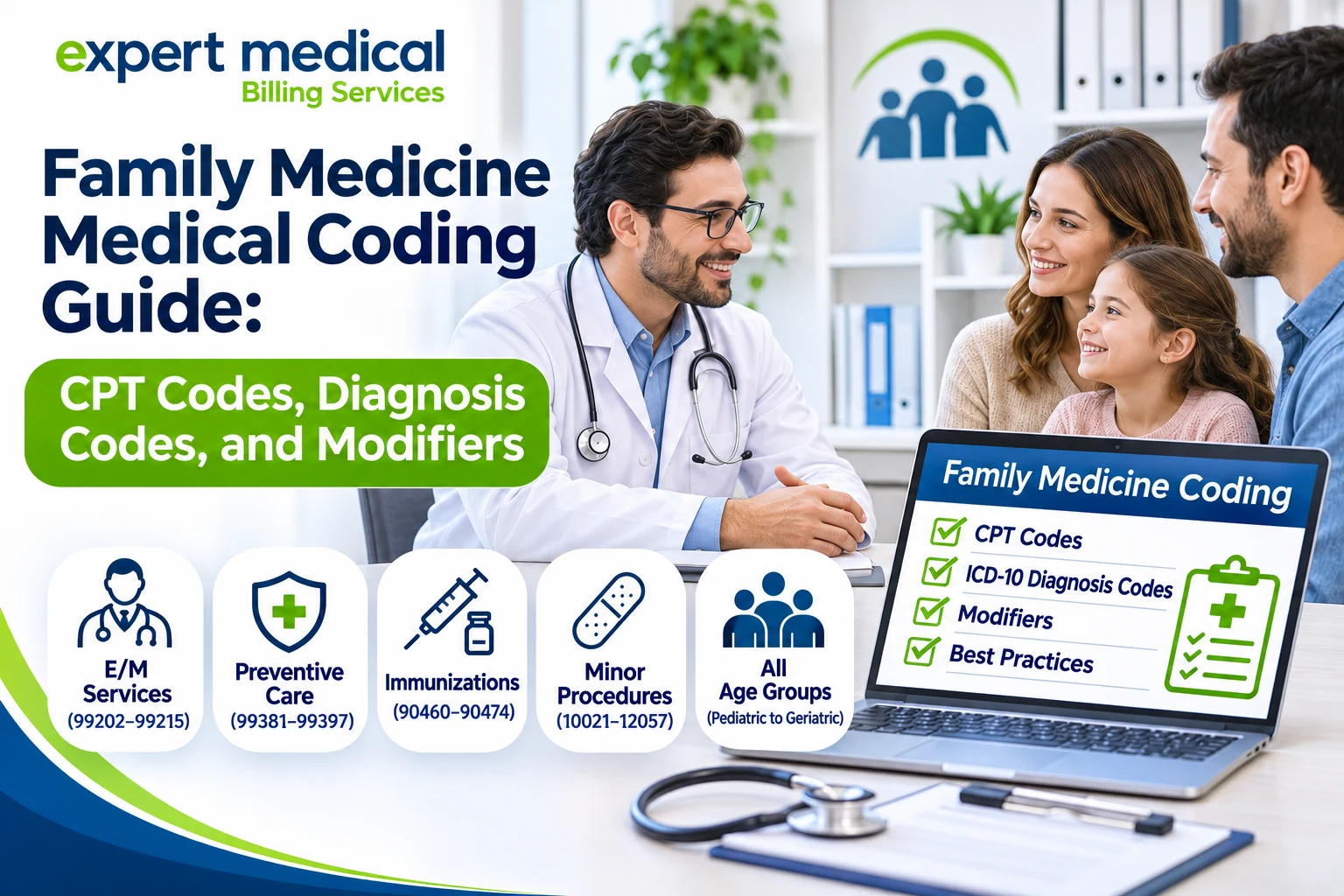
Family medicine is one of the broadest areas of healthcare. A family medicine practice may see children, adults, and older patients for preventive care, acute illnesses, chronic conditions, minor procedures, screenings, immunizations, and ongoing care management.
Because of this wide range of services, family medicine coding can become complicated quickly. Accurate coding requires more than selecting a CPT code from a list. The medical record, diagnosis, services performed, medical necessity, documentation, modifiers, and payer requirements all need to work together.
This guide explains the basics of CPT codes, diagnosis (ICD-10-CM) codes, and modifiers in family medicine, with practical examples that can help physicians, medical coders, billers, and healthcare administrators understand the coding process.
Important: Coding requirements can differ by payer and may change with annual updates. Always verify current CPT, ICD-10-CM, HCPCS, NCCI, Medicare, Medicaid, and commercial-payer requirements before submitting a claim.
What Is Family Medicine Coding?
Family medicine coding is the process of translating the healthcare services provided during a patient encounter into standardized medical codes.
Three coding components are especially important:
- CPT codes describe many of the professional services and procedures performed.
- ICD-10-CM diagnosis codes describe the patient’s conditions, symptoms, reasons for the encounter, or other applicable diagnoses.
- Modifiers provide additional information about how, where, or under what circumstances a service was performed.
Think of a claim as a story.
The CPT code tells the payer what service was performed.
The diagnosis code helps explain why the service was performed.
A modifier may explain something special about how the service should be interpreted.
If these elements do not agree with the medical record, the claim may be questioned, denied, or require additional review.
Why Accurate Coding Matters in Family Medicine
Accurate coding is important for several reasons.
1. It supports appropriate reimbursement
Healthcare organizations depend on accurate claims to receive appropriate payment for services that were actually provided and documented.
2. It communicates medical necessity
Diagnosis coding helps establish the clinical reason for a service. The diagnosis should be supported by the provider’s documentation and should accurately reflect the patient’s condition or reason for the encounter.
3. It supports compliance
Incorrect coding can create compliance risks. Examples include reporting services that were not performed, selecting unsupported levels of service, or using modifiers without sufficient documentation.
4. It improves the medical record
Good coding begins with good documentation. When the clinical note clearly identifies the problems addressed and services provided, the coding process becomes much easier.
5. It supports accurate data
Medical codes are also used for reporting, quality measurement, healthcare analytics, utilization review, and population health activities.
CPT Codes Commonly Used in Family Medicine
Family medicine practices use a wide variety of CPT codes. The exact codes reported depend on the service provided and the documentation supporting it.
Some major categories include:
1. Office or Other Outpatient Evaluation and Management Services
Evaluation and management, commonly called E/M, codes are among the most frequently reported services in family medicine.
Examples include:
- 99202–99205 for certain new-patient office or outpatient E/M services
- 99211–99215 for certain established-patient office or outpatient E/M services
The appropriate code depends on the applicable CPT requirements and the documentation supporting the encounter.
For many office and outpatient E/M services, code selection is generally based on either:
- Medical decision making (MDM), or
- Total time on the date of the encounter, when the applicable requirements are met.
A common mistake is assuming that the complexity of the patient’s overall medical history automatically determines the E/M level. Instead, the coding decision should reflect what was actually addressed and documented during the encounter.
Example
A patient with several chronic diseases comes to the office for a routine follow-up. The provider evaluates two conditions, reviews relevant information, adjusts treatment, and documents the management plan.
The coder should examine the documented work and applicable E/M rules rather than simply selecting the highest level because the patient has multiple diagnoses.
2. Preventive Medicine Services
Preventive visits are another important part of family medicine.
Preventive medicine CPT codes may apply when the primary purpose of the encounter is health maintenance rather than evaluation and management of a specific problem.
Examples include preventive services for:
- New patients
- Established patients
- Different age groups
- Routine health examinations
The documentation should support the preventive components required for the applicable service.
It is also important to distinguish a preventive examination from a problem-oriented E/M service.
A patient may arrive for an annual physical and also report a new medical concern. Whether an additional problem-oriented E/M service can be reported depends on the circumstances, the work performed, the documentation, and applicable coding and payer rules.
3. Immunization and Vaccine Administration
Family medicine offices frequently provide vaccinations.
Coding may involve separate components for:
- The vaccine product
- Vaccine administration
- Counseling, when applicable
- Other required reporting elements
The correct code depends on the vaccine, route, age group, counseling circumstances, number of components, and current CPT/HCPCS guidance.
Because immunization coding can involve detailed rules, coders should avoid relying on memory alone.
4. Chronic Disease Management
Family medicine providers commonly manage conditions such as:
- Hypertension
- Diabetes
- Asthma
- Chronic obstructive pulmonary disease
- Hyperlipidemia
- Thyroid disorders
- Obesity
- Osteoarthritis
- Chronic kidney disease
A chronic condition by itself does not determine the E/M code.
The coder should look at what was actually evaluated and managed during the encounter.
For example, if a provider reviews a patient’s blood pressure readings, evaluates medication effectiveness, discusses treatment options, and modifies the management plan, those documented activities may contribute to the appropriate E/M service selection.
5. Minor Procedures
Family medicine providers may perform various office procedures depending on their training and scope of practice.
Examples may include:
- Lesion-related procedures
- Wound care
- Foreign-body removal
- Simple repairs
- Drainage procedures
- Biopsy-related services
- Nail procedures
- Joint or soft-tissue procedures
Each procedure has its own CPT requirements.
One of the most important coding principles is to determine whether a procedure is separately reportable or included in another service.
Coders should review the applicable CPT guidelines, National Correct Coding Initiative edits when applicable, and payer-specific policies.
Understanding Diagnosis or DX Codes in Family Medicine
CPT codes explain the service. ICD-10-CM diagnosis codes explain the patient’s condition or reason for the encounter.
For example, a family medicine claim might contain an E/M service along with diagnosis codes representing conditions that were evaluated or managed.
Common diagnosis categories in family medicine include:
- Essential hypertension
- Type 2 diabetes mellitus
- Hyperlipidemia
- Obesity
- Asthma
- Depression
- Anxiety
- Acute respiratory infections
- Cough
- Back pain
- Joint pain
- Preventive examination
- Screening encounters
The exact ICD-10-CM code should always be selected based on the provider’s documentation.
The Importance of Diagnosis Specificity
A major coding principle is to report the most specific diagnosis that is supported by the medical record.
For example, if the documentation clearly identifies a particular condition, a coder should not automatically choose an unspecified diagnosis merely because it is easier to locate.
At the same time, coders should never infer a diagnosis that the provider did not document simply because the clinical circumstances appear to suggest it.
In other words:
Code what is documented, not what you assume.
This distinction is particularly important in family medicine because patients often present with multiple symptoms and chronic conditions during the same encounter.
CPT and ICD-10-CM: How They Work Together
CPT and ICD-10-CM serve different purposes, but they must make clinical sense together.
Consider a hypothetical hypertension follow-up.
The CPT code represents the evaluation and management service performed.
The ICD-10-CM code represents the documented hypertension diagnosis being evaluated or managed.
If the provider also evaluates another condition during the same encounter, that condition may need to be reported when supported by the documentation and coding requirements.
The goal is not to attach as many diagnosis codes as possible.
The goal is to report accurate, relevant, documented diagnoses.
Understanding Modifiers in Family Medicine Coding
Modifiers are two-character additions to certain procedure or service codes that provide additional information about the circumstances surrounding the service.
Modifiers can be useful, but they must be used carefully.
A modifier is not simply a tool for overcoming a claim edit or obtaining payment.
The medical record must support its use.
Below are several modifiers that family medicine coders may encounter.
Modifier -25: Significant, Separately Identifiable E/M Service
Modifier -25 is commonly discussed in family medicine because a patient may receive an E/M service and another procedure during the same encounter.
The modifier may be appropriate when the E/M service is significant and separately identifiable from the procedure or other service performed on the same date.
Example
A patient comes to the office for evaluation of several symptoms. During the encounter, the provider also performs a procedure.
If the documentation supports a significant, separately identifiable E/M service beyond the work inherent in the procedure, an E/M code with modifier -25 may be appropriate.
However, the fact that two services occurred on the same date does not automatically justify modifier -25.
The documentation must demonstrate the separate E/M work.
Modifier -59: Distinct Procedural Service
Modifier -59 is used in specific circumstances to indicate that a service was distinct or independent from another service reported on the same date.
It may be relevant when services are normally subject to a bundling or edit relationship but are separately reportable because the circumstances meet the applicable requirements.
Possible circumstances may involve:
- Different encounters
- Different procedures
- Different anatomical sites
- Separate lesions
- Other qualifying circumstances
Modifier -59 should not be used simply because two procedure codes appear together on a claim.
Where a more specific modifier is available and appropriate, that option may need to be considered.
Modifier -24: Unrelated E/M Service During a Postoperative Period
Modifier -24 may apply when an E/M service is provided during a postoperative period but is unrelated to the procedure for which the postoperative period exists.
For example, if a patient is in a postoperative period following one procedure but visits the family medicine office for an unrelated medical problem, modifier -24 may be relevant when all requirements are satisfied.
Documentation should clearly support the unrelated nature of the E/M service.
Modifier -26 and Technical Components
Some diagnostic services can involve professional and technical components.
Modifier -26 generally identifies the professional component when the applicable code and circumstances support separate reporting.
The technical component may be reported using the appropriate technical-component mechanism when applicable.
Family medicine practices should verify whether a particular service has professional and technical components before applying these modifiers.
Telehealth and Modifiers
Telehealth coding continues to evolve, and requirements can differ by payer and service.
Depending on the service and payer, claims may involve:
- Specific CPT/HCPCS codes
- Place-of-service reporting
- Modifier requirements
- Audio-video versus other communication methods
- Provider-location requirements
- Patient-location requirements
- Documentation requirements
Because telehealth rules can change, coders should verify the current payer guidance instead of relying on an old modifier list.
Practical Coding Examples
The following examples are simplified educational scenarios. They are not intended to replace official coding guidance.
Example 1: Hypertension Follow-Up
A patient returns to the family medicine office for management of hypertension. The provider reviews the patient’s home blood pressure readings, evaluates medication effectiveness, discusses lifestyle changes, and establishes a treatment plan.
Coding approach
The coder should:
- Determine the appropriate office/outpatient E/M service based on the applicable CPT rules.
- Report the documented hypertension diagnosis.
- Review the documentation to determine whether other conditions were actually addressed.
- Confirm that the selected diagnosis supports the medical necessity of the service.
The presence of hypertension alone does not automatically determine the E/M level.
Example 2: Preventive Examination With a Separate Problem
A patient schedules a routine preventive examination. During the visit, the patient also reports a new problem that requires a separate evaluation and management service.
The provider performs the preventive service and conducts additional work to evaluate the problem.
Coding approach
Depending on the documentation and applicable rules, the preventive service and a separately identifiable problem-oriented E/M service may both be reportable.
If the requirements for modifier -25 are met, the modifier may be appended to the problem-oriented E/M service.
The key question is whether the additional E/M work is significant and separately identifiable—not simply whether the patient mentioned another symptom.
Example 3: Office Procedure and E/M Service
A patient presents with a medical concern that requires evaluation. The provider performs an office procedure during the same encounter.
The coder should determine:
- What service was performed?
- What work was included in the procedure?
- Was a separate E/M service performed?
- Was the E/M service significant and separately identifiable?
- Does documentation support separate reporting?
- Do coding edits affect the services?
- Does the payer have additional requirements?
Only after answering these questions should the coder determine whether an E/M code and modifier -25 are appropriate.
Common Family Medicine Coding Mistakes
Even experienced practices can encounter coding problems. Some errors occur repeatedly.
1. Choosing the E/M Level Based on Diagnosis Count
Having five diagnoses does not automatically justify a high-level E/M code.
The coding decision should be based on the applicable CPT methodology and the work documented.
2. Reporting Every Diagnosis in the Patient’s Chart
A patient’s problem list may contain many conditions.
That does not mean every condition should be reported for every encounter.
Diagnosis selection should reflect the conditions relevant to the services provided and the documentation supporting them.
3. Using Modifier -25 Automatically
Modifier -25 should not be added simply because an E/M service and procedure were performed on the same date.
The E/M service must meet the applicable requirements for separate reporting.
4. Using Modifier -59 as a General-Purpose Override
Modifier -59 should not be treated as a universal solution for coding edits.
The circumstances must meet the requirements for a distinct procedural service.
5. Coding From the Medication List Alone
A medication may suggest that a patient has a particular condition, but coders should not independently diagnose the patient from medications.
The diagnosis should be supported by provider documentation.
6. Ignoring Payer-Specific Rules
Medicare, Medicaid programs, and commercial insurance companies may have different billing requirements.
A code that is technically valid under CPT may still be subject to payer-specific coverage or billing rules.
Documentation Tips for Family Medicine Providers
Good coding starts with good clinical documentation.
Providers can make the coding process easier by clearly documenting:
The reason for the encounter
Explain why the patient is being seen.
Problems addressed
Identify the conditions that were actually evaluated or managed.
Clinical assessment
Document the provider’s assessment of the patient’s condition.
Management decisions
Include relevant treatment decisions, medication changes, testing, referrals, or follow-up plans.
Procedures performed
Clearly document procedures and the relevant procedural work.
Separately identifiable services
When an E/M service is performed in addition to a procedure, documentation should support the separate nature and significance of the E/M work when applicable.
A Simple Family Medicine Coding Workflow
A consistent workflow can reduce errors.
Step 1: Read the clinical note
Do not begin by searching for a code before understanding the encounter.
Step 2: Identify the services performed
Determine whether the encounter involved an E/M service, preventive service, procedure, immunization, testing, or another billable service.
Step 3: Determine the appropriate CPT or HCPCS code
Use the current code set and applicable guidelines.
Step 4: Identify documented diagnoses
Select the appropriate ICD-10-CM codes supported by the record.
Step 5: Review medical necessity
Confirm that the diagnosis and documentation support the reported service.
Step 6: Check for modifiers
Determine whether a modifier is required or appropriate based on the circumstances.
Step 7: Review coding edits
Check applicable NCCI edits and payer-specific rules.
Step 8: Perform a final documentation check
Make sure the claim tells the same story as the medical record.
Family Medicine Coding Quick Reference
| Coding Element | What It Communicates | Example |
| CPT | Service or procedure performed | Office/outpatient E/M |
| ICD-10-CM | Diagnosis or reason for encounter | Hypertension |
| Modifier | Special circumstances surrounding a service | -25 |
| HCPCS | Certain healthcare services, supplies, drugs, and other items | Vaccine-related services |
| Documentation | Clinical support for the codes | Assessment and plan |
| Medical necessity | Why the service was appropriate | Evaluation of a documented condition |
Frequently Asked Questions About Family Medicine Coding
1. What CPT codes are commonly used in family medicine?
Family medicine commonly uses CPT codes for office and outpatient evaluation and management (E/M) services, preventive examinations, immunizations, minor procedures, screening services, and care-management services. The correct CPT code depends on the service performed and the documentation supporting that service.
2. What is the difference between CPT and ICD-10-CM codes?
CPT codes generally describe the healthcare service or procedure performed, while ICD-10-CM codes describe the patient’s diagnosis, condition, symptom, or reason for the encounter. Both may be needed to accurately represent a family medicine visit.
3. What are diagnosis or DX codes in family medicine?
DX codes generally refer to diagnosis codes reported using ICD-10-CM. They identify conditions, symptoms, preventive encounters, or other reasons for which a patient received care. The selected diagnosis should be supported by the provider’s documentation.
4. How are E/M codes selected in family medicine?
Office and outpatient E/M code selection generally depends on the applicable CPT requirements, including medical decision making or total time on the date of the encounter when permitted. The number of diagnoses alone does not determine the E/M level.
5. When is modifier -25 used in family medicine?
Modifier -25 may be appropriate when a significant, separately identifiable E/M service is performed on the same day as another procedure or service. Documentation must support the additional E/M work. Modifier -25 should not be added automatically whenever an E/M service and procedure occur together.
6. What is modifier -59 used for?
Modifier -59 identifies a distinct procedural service when the circumstances meet the applicable coding requirements. It may be relevant when services would otherwise be considered related or bundled but are separately reportable because they were distinct.
7. Can a preventive visit and problem-oriented E/M service be billed on the same day?
In some circumstances, both services may be reportable. The provider must perform and document a separately identifiable problem-oriented E/M service in addition to the preventive service, and all applicable CPT and payer requirements must be met. Modifier -25 may be relevant when its requirements are satisfied.
8. Should every diagnosis on a patient’s problem list be reported?
No. A patient’s complete problem list does not automatically represent the diagnoses that should be reported for a particular encounter. Diagnosis coding should reflect conditions that are relevant to the encounter and supported by the documentation.
9. Why is documentation important for family medicine coding?
Documentation provides the clinical support for the services and diagnoses reported on a claim. Clear documentation can help demonstrate medical necessity, support appropriate code selection, reduce errors, and make the claim easier to review.
10. Can coders assign a diagnosis based only on the patient’s medication?
Generally, coders should not independently infer a diagnosis simply from a medication list. The diagnosis should be supported by the provider’s documentation and the applicable coding guidelines.
11. Are family medicine coding rules the same for every insurance company?
Not necessarily. Although CPT and ICD-10-CM provide standardized coding systems, individual payers may have different coverage, reimbursement, modifier, documentation, and claim-submission requirements. Payer-specific policies should therefore be reviewed.
12. Does a higher number of diagnoses mean a higher E/M code?
No. The number of diagnoses by itself does not determine the E/M level. The appropriate level should be selected using the applicable CPT methodology and the work documented during the encounter.
13. How often should family medicine practices review their coding guidelines?
Coding resources and payer requirements can change regularly, including annual code-set updates. Practices should establish a process for reviewing current CPT, ICD-10-CM, HCPCS, NCCI, Medicare, Medicaid, and payer-specific guidance.
14. What are some common family medicine coding errors?
Common problems include selecting unsupported E/M levels, reporting diagnoses that were not addressed, using unspecified diagnosis codes when greater specificity is documented, incorrectly applying modifiers, overlooking bundling edits, and failing to follow payer-specific requirements.
15. What is the best way to improve family medicine coding accuracy?
Start with clear clinical documentation and use a consistent coding workflow. Review the encounter, identify the services performed, select the appropriate CPT or HCPCS codes, assign supported ICD-10-CM diagnoses, evaluate modifier requirements, and check applicable payer and coding guidelines before submitting the claim.
16. Why should family medicine coders stay current with coding updates?
CPT, ICD-10-CM, HCPCS, payer policies, and coding edits can change over time. Staying current helps coding teams report services accurately, reduce avoidable errors, and maintain compliance with current requirements.
Conclusion
Accurate family medicine coding is an important part of delivering and documenting quality healthcare. Because family medicine covers a wide range of preventive, acute, and chronic care services, selecting the correct CPT codes, ICD-10-CM diagnosis codes, and modifiers requires careful attention to both the clinical documentation and current coding guidelines.
The key is to make sure every code accurately reflects the care that was provided. CPT codes should represent the services performed, diagnosis codes should support the conditions or reasons documented for the encounter, and modifiers should only be used when the circumstances and documentation support them.
A consistent coding process can help family medicine practices reduce billing errors, avoid unnecessary claim denials, support medical necessity, and maintain stronger compliance. Most importantly, good coding should tell the same story as the patient’s medical record.
As coding guidelines and payer requirements continue to change, regular education and review are essential. By keeping documentation clear, using current coding resources, and applying CPT, ICD-10-CM, and modifier rules appropriately, family medicine practices can create a more accurate, efficient, and reliable coding process.