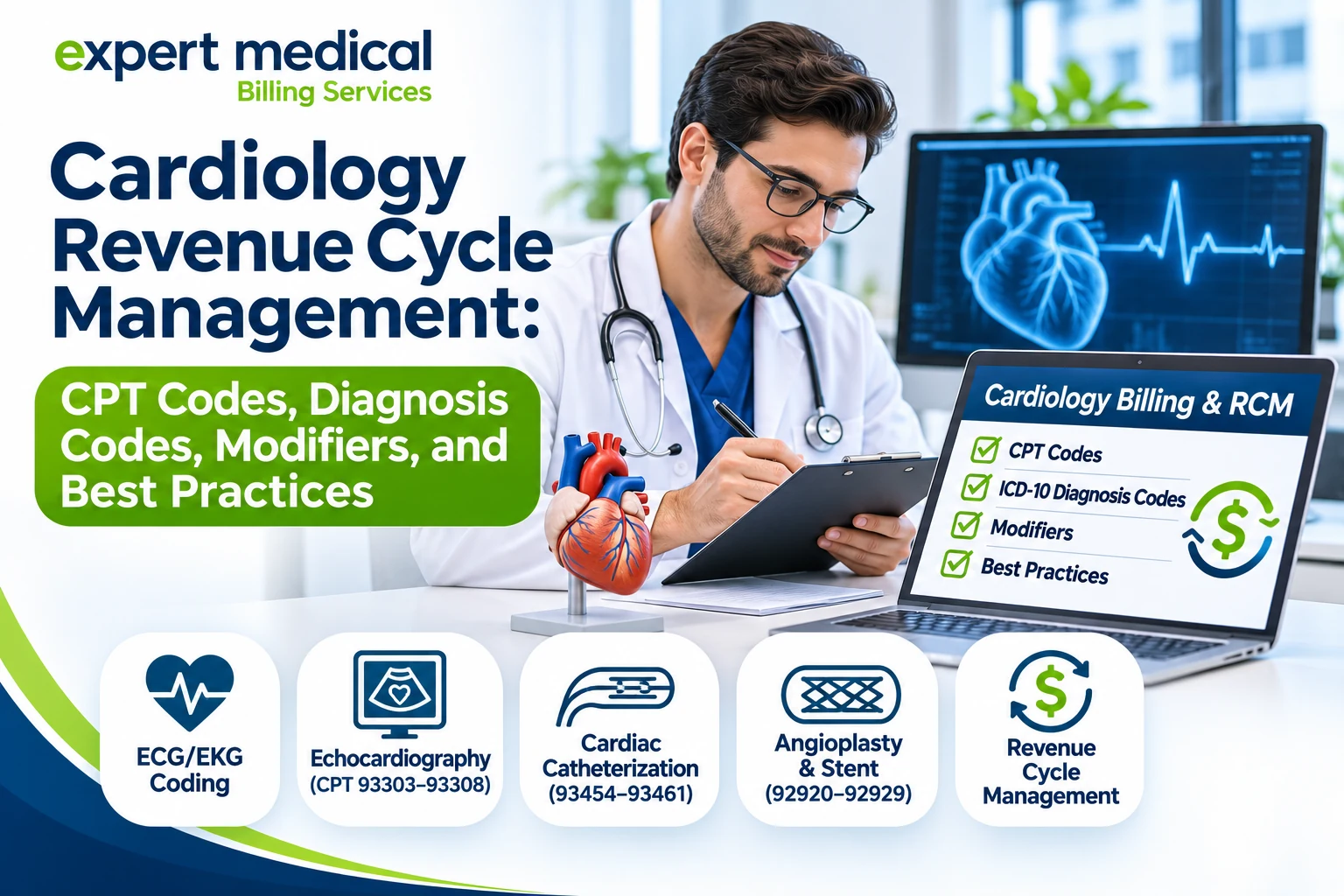
Cardiology is one of the medical specialties where accurate billing and coding can make a significant difference in a practice’s revenue cycle. Cardiologists may provide everything from routine office evaluations and electrocardiograms to advanced diagnostic testing, cardiac catheterization, coronary interventions, and ongoing monitoring.
Because cardiology involves a wide range of services, selecting the correct procedure code, diagnosis code, and modifier requires careful attention to the medical record. A small coding mistake can lead to claim delays, denials, incorrect reimbursement, or unnecessary follow-up work.
What Is Cardiology Medical Billing?
Cardiology medical billing is the process of translating cardiovascular services documented by a physician or qualified healthcare professional into standardized billing information that can be submitted to an insurance payer.
A cardiology claim may contain several important components:
- CPT code for the service or procedure performed
- ICD-10-CM code supporting the diagnosis or reason for the service
- Appropriate modifiers when circumstances require them
- Patient and provider information
- Medical necessity documentation
- Insurance and authorization information
- Applicable payer-specific billing requirements
CPT codes provide a standardized way to report medical procedures and services. The American Medical Association describes CPT as a uniform language used to report services and procedures performed by physicians and other qualified healthcare professionals.
In simple terms:
CPT explains what was performed.
ICD-10-CM explains the documented diagnosis or reason for the encounter.
Modifiers provide additional information about how, where, or under what circumstances a service was performed.
When these elements work together correctly, the claim has a stronger foundation for accurate processing.
Why Accurate Cardiology Coding Matters?
Cardiology practices often handle complex services that require detailed documentation and precise coding. Using an incorrect code can create problems that extend beyond a single claim.
Common consequences of inaccurate coding include:
- Claim denials
- Payment delays
- Incorrect reimbursement
- Coding-related audits
- Rework for billing staff
- Patient billing confusion
- Increased accounts receivable
- Potential compliance concerns
Accurate coding also helps ensure that the patient’s medical record and the submitted claim tell the same story.
For example, if a cardiologist documents an evaluation for palpitations and performs an ECG, the claim should accurately reflect the services actually performed and the diagnosis supported by the documentation.
Coding should never be based simply on what seems likely. The medical record should support the reported diagnosis and service.
CMS’s ICD-10-CM guidelines emphasize the importance of complete and accurate documentation and state that the entire record should be reviewed to determine the specific reason for the encounter and the conditions treated.
Common Cardiology CPT Codes
Cardiology practices use a broad range of CPT codes. The correct code depends on the exact service performed, the documentation, the patient’s circumstances, and applicable coding rules.
Below are examples of commonly encountered cardiology-related CPT code ranges.
| CPT Code/Range | Common Service Area |
| 93000–93010 | Electrocardiography (ECG/EKG) services |
| 93303–93308 | Echocardiography services |
| 93320–93325 | Doppler and related echocardiographic services |
| 93454–93461 | Coronary angiography/cardiac catheterization services |
| 93566–93571 | Certain cardiac catheterization add-on services |
| 92920–92921 | Coronary angioplasty services |
| 92928–92929 | Coronary stent-related services |
| 93224–93227 | Holter/ambulatory ECG monitoring services |
| 93241–93248 | Extended ambulatory ECG monitoring |
Important: This table is intended as an educational overview, not a substitute for the current CPT codebook. CPT code descriptions, guidelines, bundling rules, and reporting requirements should be verified in the current official CPT code set before claims are submitted. The AMA’s 2026 CPT release included hundreds of changes, demonstrating why relying on outdated code lists can create billing problems.
Understanding ECG and EKG Coding
Electrocardiography is frequently performed in cardiology offices and other healthcare settings.
An ECG records the electrical activity of the heart and may be ordered for symptoms or conditions such as palpitations, chest discomfort, arrhythmias, or other cardiovascular concerns.
When reporting an ECG-related service, the billing team should carefully review the documentation to determine what was actually performed and whether the service includes the appropriate components.
A common area requiring attention is the distinction between professional and technical components.
Professional Component – Modifier 26
Modifier 26 may be applicable when billing only the professional component of a service, when the coding and payer rules permit its use.
The professional component generally relates to the physician’s professional work, such as interpretation and reporting, rather than the technical resources used to perform the service.
Technical Component – Modifier TC
Modifier TC may be used in applicable circumstances when reporting the technical component of a service.
Whether a service can be divided into professional and technical components depends on the specific CPT code and payer rules.
The billing team should verify the code’s component status rather than automatically applying modifier 26 or TC.
Echocardiography Billing
Echocardiography is another major area of cardiology billing.
Different echocardiographic services may involve different techniques, measurements, and levels of diagnostic evaluation. This makes documentation especially important.
Before submitting an echocardiography claim, the billing team should confirm:
- The exact type of study performed
- The documentation supporting the service
- Whether interpretation and reporting requirements were met
- Whether professional or technical components are being reported
- The diagnosis supporting medical necessity
- Whether payer-specific requirements apply
The CPT code should describe the service that was actually performed—not a similar service that might have been performed.
Common ICD-10-CM Diagnosis Codes in Cardiology
ICD-10-CM codes identify diagnoses, symptoms, conditions, or reasons for healthcare encounters.
Examples commonly encountered in cardiology include:
| ICD-10-CM Code | Example Description |
| I10 | Essential hypertension |
| I25.10 | Atherosclerotic heart disease of native coronary artery without angina pectoris |
| I50.9 | Heart failure, unspecified |
| I48.91 | Unspecified atrial fibrillation |
| R07.9 | Chest pain, unspecified |
| R00.2 | Palpitations |
| R06.02 | Shortness of breath |
These examples should not be treated as automatic diagnosis choices for particular procedures.
The diagnosis reported should be supported by the provider’s documentation and selected according to the applicable ICD-10-CM guidelines.
For example, if a patient presents with chest pain and the provider has not established a definitive cardiac diagnosis, a documented symptom may be more appropriate than assuming a specific heart disease.
This is one reason communication between the provider, coder, and billing team is so important.
Cardiology Modifiers: What Billing Teams Should Know
Modifiers provide additional information about a procedure or service. However, they should not be used simply because a claim is expected to deny without them.
A modifier must accurately describe the circumstances supported by the documentation.
Modifier 25 – Significant, Separately Identifiable E/M Service
Modifier 25 may be appended to an appropriate E/M service when the provider performs a significant, separately identifiable E/M service on the same date as another procedure or service.
For example, a cardiologist may evaluate a patient’s new cardiovascular complaint and also perform a separately reportable procedure during the same visit.
The documentation must support the separately identifiable E/M service.
CMS specifically notes that modifier 25 may be used with an E/M code when a significant and separately identifiable E/M service is reported with another procedure or service on the same day.
Modifier 26 – Professional Component
Modifier 26 can identify the professional component of an applicable service when the physician or qualified professional provides that portion of the service.
Modifier TC – Technical Component
Modifier TC identifies the technical component when applicable.
Modifier 59 – Distinct Procedural Service
Modifier 59 is one of the most frequently misunderstood modifiers.
It may be appropriate when two procedures that are normally considered bundled are actually distinct because of circumstances such as a different encounter, different anatomical site, or another qualifying situation.
CMS cautions that modifier 59 should only be used when the appropriate criteria are met and when another more specific modifier does not better describe the circumstances.
Modifier 59 should never be treated as a routine “denial bypass” modifier.
CMS also states that modifier 59 is not used on an E/M service; modifier 25 is used for an appropriate separately identifiable E/M service.
Modifiers 76 and 77
Modifiers 76 and 77 may be relevant when a procedure is repeated under circumstances that meet the applicable reporting requirements.
The distinction between the modifiers relates to whether the repeat procedure was performed by the same or another physician or qualified healthcare professional.
Again, documentation and payer-specific rules should be reviewed before reporting these modifiers.
Modifiers 52 and 53
Modifiers 52 and 53 may be relevant when a service is reduced or discontinued under circumstances defined by CPT and applicable payer rules.
These modifiers should not be added simply because a procedure took less time than expected or because the reimbursement amount is lower than anticipated.
Medical Necessity and Cardiology Claims
Medical necessity is a critical part of successful cardiology billing.
A procedure may be performed correctly, but the claim can still encounter problems if the diagnosis does not adequately support the service under the payer’s coverage requirements.
For this reason, the billing team should compare:
Provider documentation → Diagnosis → Procedure → Payer requirements
For example, if an advanced cardiac diagnostic test is performed, the record should contain appropriate clinical information supporting why the service was medically necessary.
The diagnosis should come from the documentation. Coders should not create or assume a diagnosis merely because it would make a procedure easier to justify.
Cardiology Billing and NCCI Edits
The National Correct Coding Initiative, commonly known as NCCI, is another important consideration for cardiology billing.
NCCI Procedure-to-Procedure edits are designed to prevent improper reporting of certain code combinations. Some code pairs may only be reported together when specific circumstances exist.
CMS explains that NCCI-associated modifiers can be used only when the clinical circumstances support their use. CMS also identifies circumstances such as separate encounters, separate anatomical sites, or separate specimens as examples relevant to certain NCCI modifier applications.
Before submitting a cardiology claim, billing teams should review applicable NCCI edits and determine whether the services are separately reportable.
The presence of a denial does not automatically mean that modifier 59—or another modifier—should be added.
Common Cardiology Billing Mistakes
Even experienced billing teams can encounter cardiology claims that require additional review.
Some common issues include:
1. Selecting a Code That Does Not Match the Documentation
The service documented in the medical record should support the CPT code reported.
2. Using an Unsupported Diagnosis
A diagnosis should be based on provider documentation and applicable ICD-10-CM guidelines.
3. Misusing Modifiers
Modifiers should describe actual billing circumstances. They should not be used as a shortcut to overcome an edit.
4. Ignoring Professional and Technical Components
When a service has separately reportable components, the billing team should understand which portion was provided and what the payer requires.
5. Missing Medical Necessity
A claim may need documentation or a diagnosis that supports the payer’s coverage criteria.
6. Failing to Check Payer Policies
Medicare, Medicaid, and commercial insurers may have different policies, authorization requirements, coverage rules, and claim-processing instructions.
7. Using Outdated Codes
Medical coding changes regularly. Using an old code list can result in incorrect claims.
The AMA’s CPT 2026 update included 288 new codes, 84 deletions, and 46 revisions, illustrating how important annual code-set updates are.
How to Reduce Cardiology Claim Denials
A strong pre-submission review process can prevent many avoidable billing problems.
Here is a practical cardiology claim checklist:
Verify Patient Information
Make sure the patient’s demographic and insurance information is accurate.
Confirm Eligibility
Check coverage and benefits before services when appropriate.
Review Authorization Requirements
Some procedures may require prior authorization depending on the payer and patient’s plan.
Match CPT to Documentation
Make sure the procedure code accurately reflects the documented service.
Verify ICD-10-CM Coding
Use the diagnosis supported by the provider’s documentation.
Review Modifiers
Confirm that each modifier is necessary, supported, and appropriate for the service.
Check NCCI Edits
Review applicable procedure-to-procedure edits before submitting the claim.
Review Medical Necessity
Make sure the diagnosis and documentation support the service under the applicable payer policy.
Submit Complete Claims
Check for missing information, incorrect provider details, or other claim errors.
Monitor Denials
When a claim is denied, identify the underlying reason rather than simply resubmitting the same claim.
CMS maintains current NCCI policy resources and updates its Medicare NCCI Policy Manual annually, making these resources important for billing teams that work with Medicare claims.
The Importance of Documentation in Cardiology
Accurate coding begins with accurate documentation.
A cardiology record may need to clearly establish:
- The patient’s reason for the encounter
- Relevant symptoms
- Diagnoses evaluated or treated
- Services and procedures performed
- Medical necessity
- Test findings and interpretations when applicable
- Treatment decisions
- Follow-up plans
- Other information required by the applicable coding and payer rules
A coder cannot accurately report information that is not documented.
This is why healthcare providers and coding professionals should work together. Clear clinical documentation makes it easier for the billing team to select appropriate codes and submit cleaner claims.
CPT, ICD-10-CM, and Modifiers: Putting It All Together
Think of a cardiology claim as a story.
The CPT code tells the payer what service was performed.
The ICD-10-CM code explains the documented diagnosis, condition, symptom, or reason for the encounter.
The modifier provides additional information when the circumstances surrounding the service require clarification.
The claim becomes stronger when all three elements are consistent with the medical record.
For example:
Patient presents with a documented cardiovascular complaint → Cardiologist performs and documents an appropriate evaluation → A diagnostic service is performed → CPT reports the service → ICD-10-CM reports the supported diagnosis or symptom → Modifier is added only when the circumstances justify it.
This approach keeps coding focused on accuracy rather than simply maximizing reimbursement.
Why Cardiology Practices Benefit From Professional Billing Support
Managing cardiology billing internally can require significant time and attention. Staff members must keep up with coding changes, payer policies, claim edits, documentation requirements, eligibility checks, denials, and follow-up.
Professional medical billing support can help practices create a more organized revenue cycle.
At Expert Medical Billing Services (EMBS), our focus is helping healthcare providers manage the administrative side of their revenue cycle so they can spend more time concentrating on patient care.
A reliable billing process can help practices work toward:
- Cleaner claims
- Fewer avoidable denials
- Better claim follow-up
- More organized accounts receivable
- Improved reimbursement processes
- Greater visibility into billing performance
Final Thoughts
Cardiology billing requires more than simply knowing a list of CPT codes.
Successful billing depends on bringing together accurate documentation, appropriate CPT coding, supported ICD-10-CM diagnoses, correct modifier usage, medical necessity, NCCI review, and payer-specific requirements.
Because coding systems are regularly updated, billing professionals should always verify codes and guidelines against the current official resources before submitting claims. The AMA’s current CPT resources and CMS’s ICD-10-CM and NCCI resources are useful starting points for staying current.
When cardiology coding is handled carefully, practices can reduce avoidable billing errors and create a stronger foundation for their overall revenue cycle.
Accurate coding is not just about getting a claim paid. It is about making sure the claim accurately represents the care that was provided.
About EMBS
Expert Medical Billing Services (EMBS) provides medical billing and revenue cycle support designed to help healthcare providers simplify billing, improve claim management, and maintain a more efficient revenue cycle.
Disclaimer: This article is intended for general educational and informational purposes. CPT, ICD-10-CM, NCCI, coverage policies, and payer requirements can change. Always verify current code descriptions, coding guidelines, payer policies, and documentation requirements before submitting a claim.