
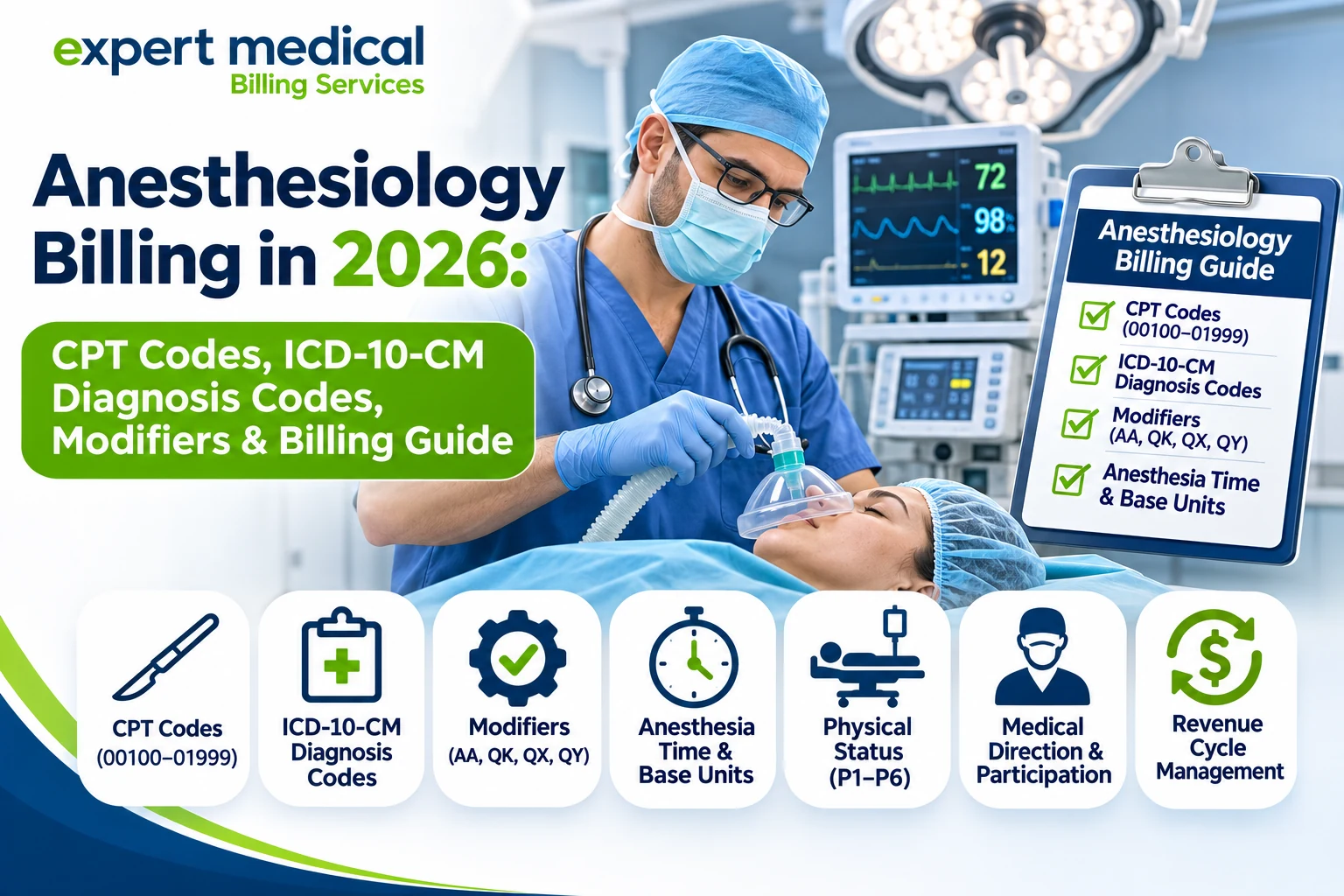
Anesthesiology billing is one of the more specialized areas of medical billing. Unlike many other specialties, anesthesia, reimbursement can depend on several factors at the same time, including the procedure performed, anesthesia time, base units, patient condition, provider involvement, modifiers, documentation, and payer-specific requirements.
A small mistake in any of these areas can lead to claim delays, underpayments, or denials.
For anesthesiology practices, accurate coding is not simply about selecting a CPT code. The billing team must understand the complete clinical picture and make sure the claim reflects the services that were actually provided.
In this guide, we will explore the fundamentals of anesthesiology billing, commonly used CPT codes, diagnosis coding, anesthesia modifiers, physical-status modifiers, qualifying circumstances, anesthesia time, common billing mistakes, and ways to improve the revenue cycle.
What Is Anesthesiology Billing?
Anesthesiologists and other qualified anesthesia professionals may provide service before, during, and after a surgical a diagnostic procedure. The billing process must accurately represent the anesthesia service and comply with requirements of the patient’s insurance plan
CMS maintains specific guidance for anesthesia services and identifies anesthesia CPT codes in the 00100-01999 range. CMS also publishes anesthesia-specific conversion-factor information used in Medicare payment calculations.
Unlike simply billing for the surgical procedure itself, anesthesia billing can involve additional considerations such as:
- Anesthesia base units
- Anesthesia time
- Medical direction
- Provider participation
- Physical status
- Qualifying circumstances
- Monitored anesthesia care
- Patient diagnosis
- Documentation
- Payer-specific reimbursement policies
This makes accurate anesthesia billing particularly important for maintaining a healthy revenue cycle.
How Does Anesthesia Billing Work?
Anesthesia claims generally require more than just selecting a procedure code.
A billing professional may need to review:
The surgical or diagnostic procedure
The type of anesthesia provided
The anesthesia CPT code
The assigned base units
The actual anesthesia time
The provider’s role
Applicable modifiers
Patient diagnoses
Documentation
Insurance-specific billing requirements
For Medicare, anesthesia payment methodology incorporates factors such as base units, time units, and an anesthesia-specific conversion factor.
A simplified representation is:
Anesthesia Payment ≈ (Base Units + Time Units + Applicable Additional Units) × Conversion Factor
This is only a general illustration. Actual reimbursement depends on the applicable payer, contract, geographic factors, claim circumstances, and other payment rules.
Understanding Anesthesia CPT Codes
Anesthesia services are represented by specific CPT codes. CMS’s current anesthesia resources cover the 00100–01999 range, and its 2026 NCCI manual includes a dedicated chapter for anesthesia services.
Anesthesia codes are generally organized according to the procedure or anatomical area involved.
Some broad anesthesia code categories include:
| CPT Range | General Category |
| 00100–00222 | Anesthesia for procedures on the head and neck |
| 00300–00474 | Anesthesia for procedures involving the integumentary and musculoskeletal systems |
| 00500–00580 | Anesthesia for procedures involving the thorax |
| 00600–00770 | Anesthesia for procedures involving the spine and upper abdomen |
| 00790–00882 | Anesthesia for abdominal and lower abdominal procedures |
| 00902–00952 | Anesthesia for procedures involving the perineum and genitalia |
| 01000–01999 | Additional anesthesia categories, including extremity, obstetric, radiological, cardiovascular, and other procedures |
The exact CPT code must be selected based on the procedure documented in the medical record. A code should not be chosen simply because it appears similar to the surgical procedure.
CMS’s 2026 NCCI guidance emphasizes reporting the CPT/HCPCS code that describes the service performed with the greatest specificity and avoiding inappropriate unbundling.
Common Anesthesiology CPT Code Examples
Below are examples of anesthesia CPT codes that may be encountered in practice. Always verify the current CPT descriptor, coding guidelines, and payer requirements before submitting a claim.
| CPT Code | General Description |
| 00100 | Anesthesia for procedures on salivary glands, including parotid |
| 00400 | Anesthesia for procedures on the integumentary system of the extremities and anterior trunk |
| 00500 | Anesthesia for procedures on the heart, pericardial sac, and great vessels |
| 00600 | Anesthesia for procedures on the cervical spine and spinal cord |
| 00700 | Anesthesia for procedures involving the upper abdomen |
| 00800 | Anesthesia for procedures involving the lower abdomen |
| 00900 | Anesthesia for procedures involving the perineum |
| 01000 | Anesthesia for procedures on the upper leg and knee region |
| 01100 | Anesthesia for procedures involving the lower leg |
| 01200 | Anesthesia for procedures involving the hip |
| 01300 | Anesthesia for procedures on the knee |
| 01400 | Anesthesia for procedures on the knee joint |
| 01500 | Anesthesia for procedures involving the lower leg |
| 01600 | Anesthesia for procedures involving the shoulder |
| 01700 | Anesthesia for procedures involving the upper arm and elbow |
| 01800 | Anesthesia for procedures involving the forearm, wrist, and hand |
These examples are intended to demonstrate the structure of anesthesia coding rather than serve as a substitute for the official CPT code set.
Diagnosis Codes in Anesthesiology Billing
Diagnosis coding is another important part of an anesthesia claim.
The ICD-10-CM diagnosis code should accurately represent the patient’s condition, reason for the procedure, or other documented circumstances supporting the service.
Depending on the clinical situation, anesthesia claims may involve diagnoses related to:
- Cardiovascular conditions
- Respiratory disorders
- Gastrointestinal conditions
- Musculoskeletal conditions
- Neurological disorders
- Endocrine conditions
- Obstetric conditions
- Acute injuries
- Chronic diseases
- Pain-related conditions
- Other documented medical conditions
Examples of ICD-10-CM Diagnosis Codes
| ICD-10-CM Code | Example Diagnosis |
| I10 | Essential hypertension |
| E11.9 | Type 2 diabetes mellitus without complications |
| J44.9 | Chronic obstructive pulmonary disease, unspecified |
| I25.10 | Atherosclerotic heart disease of native coronary artery without angina pectoris |
| K21.9 | Gastro-esophageal reflux disease without esophagitis |
| G89.18 | Other acute postprocedural pain |
| M25.561 | Pain in right knee |
| M25.562 | Pain in left knee |
These codes are examples only. The appropriate diagnosis must come from the patient’s actual clinical documentation.
The diagnosis should never be selected simply because it appears likely to support reimbursement. It must accurately reflect the patient’s documented condition.
Why Diagnosis Accuracy Matters
Anesthesia claims can sometimes require additional documentation when medical necessity is questioned.
For example, CMS guidance concerning mentioned anesthesia care explains that medical records must support the diagnoses and circumstances reported on the claim
A strong billing process therefore connects:
Clinical documentation → Diagnosis → Procedure → Anesthesia service → Modifier → Claim
When those elements tell the same clinical story, the claim is easier to review and defend.
Common Anesthesia Modifiers
Modifiers are especially important in anesthesiology billing because they can communicate how the anesthesia service was performed and who participated in the service.
Some commonly encountered anesthesia modifiers include:
AA — Personally Performed Anesthesia
Modifier AA indicates anesthesia services personally performed by an anesthesiologist.
QK — Medical Direction
Modifier QK is used for medical direction of two, three, or four concurrent anesthesia procedures involving qualified individuals, subject to applicable Medicare requirements.
QX — CRNA With Medical Direction
Modifier QX indicates a CRNA service with medical direction by a physician.
QY — Medical Direction of One CRNA
Modifier QY indicates medical direction of one CRNA by an anesthesiologist.
QZ — CRNA Without Medical Direction
Modifier QZ indicates a CRNA service without medical direction by a physician.
QS — Monitored Anesthesia Care
Modifier QS identifies monitored anesthesia care. CMS describes QS as informational and states that actual anesthesia time should still be reported on the claim.
G8 — Certain MAC Services
Modifier G8 is used for monitored anesthesia care for deep, complex, complicated, or markedly invasive surgical procedures when applicable.
G9 — Certain MAC Services for High-Risk Patients
Modifier G9 is used for monitored anesthesia care for a patient with a history of severe cardiopulmonary conditions when applicable.
CMS documentation identifies these modifiers among the anesthesia modifiers used in Medicare claims processing.
Physical Status Modifiers: P1–P6
Physical-status modifiers communicate the patient’s physical condition at the time of anesthesia.
The commonly used modifiers include:
| Modifier | General Meaning |
| P1 | Normal healthy patient |
| P2 | Patient with mild systemic disease |
| P3 | Patient with severe systemic disease |
| P4 | Patient with severe systemic disease that is a constant threat to life |
| P5 | Moribund patient who is not expected to survive without the operation |
| P6 | Declared brain-dead patient whose organs are being removed for donor purposes |
These modifiers should be supported by the clinical record and reported according to the applicable coding and payer rules.
A billing team should never select a higher physical-status modifier simply because it may appear to increase reimbursement.
Qualifying Circumstance Codes
Certain anesthesia situations may qualify for additional reporting when the specific requirements are met.
Examples include:
99100
Anesthesia for a patient of extreme age, when the applicable CPT requirements are satisfied.
99116
Anesthesia complicated by utilization of total body hypothermia.
99135
Anesthesia complicated by utilization of controlled hypotension.
99140
Anesthesia complicated by emergency conditions.
CMS’s published code information identifies 99100, 99116, 99135, and 99140 as anesthesia-related qualifying circumstance codes.
The documentation should clearly support the circumstance being reported. Payer policies should also be checked because qualifying circumstances may not be reimbursed uniformly across all insurance plans.
Understanding Anesthesia Time
Anesthesia time is one of the most important components of anesthesia billing.
The anesthesia record should clearly establish when the anesthesia service began and when it ended according to the applicable billing rules.
For example:
Anesthesia start: 9:00 AM
Anesthesia end: 10:30 AM
Total time: 90 minutes
For Medicare methodology, anesthesia time is converted into time units according to applicable rules. CMS documentation has historically described 15-minute intervals for anesthesia time calculation and provides specific payment methodology for anesthesia services.
However, billing teams should not assume that every commercial payer follows Medicare’s methodology. Contractual and payer-specific requirements should always be reviewed.
Medical Direction vs. Personally Performed Anesthesia
One of the areas that can create billing confusion is determining how the service should be reported based on provider participation.
An anesthesia service may involve:
- An anesthesiologist personally performing the service
- An anesthesiologist medically directing a CRNA or other qualified anesthesia professional
- A CRNA performing the service without physician medical direction
- Multiple concurrent anesthesia procedures
The appropriate modifier depends on the circumstances and applicable payer rules.
For Medicare, CMS identifies specific modifiers for these different circumstances, including AA, QK, QX, QY, and QZ.
Accurate documentation of provider participation is therefore essential.
Monitored Anesthesia Care (MAC)
Monitored anesthesia care is another area that requires careful billing.
MAC is not simply another word for general anesthesia. The medical record should support the level and circumstances of the service provided.
CMS notes that documentation must support medical necessity when MAC is billed under applicable coverage requirements.
A billing team should review:
- The procedure performed
- Patient condition
- Reason MAC was medically necessary
- Anesthesia documentation
- Applicable diagnosis codes
- Appropriate modifiers
- Payer-specific coverage criteria
Common Anesthesiology Billing Mistakes
Even a well-run anesthesia practice can experience billing problems when small details are overlooked.
Here are some common issues:
1. Incorrect CPT Selection
Choosing an anesthesia code that does not accurately correspond to the documented procedure can result in a claim denial or payment issue.
2. Incorrect Anesthesia Time
Incomplete or inconsistent start and stop times can create problems during claim review.
3. Incorrect Modifier
An incorrect AA, QK, QX, QY, QZ, QS, G8, or G9 modifier can change how a claim is processed.
4. Unsupported Physical Status
P1–P6 modifiers should reflect the patient’s actual documented physical status.
5. Incomplete Documentation
If the medical record does not support the service reported on the claim, the payer may request additional information or deny payment.
6. Incorrect Diagnosis Coding
A diagnosis that does not match the patient’s medical record can create medical-necessity concerns.
7. Ignoring Payer-Specific Rules
Medicare, Medicaid, and commercial insurance plans may have different billing requirements.
8. Unbundling Services
Services that are included in an anesthesia service should not automatically be billed separately. CMS’s 2026 NCCI anesthesia chapter specifically addresses correct coding and inappropriate unbundling.
9. Duplicate Claims
Submitting the same service more than once can create avoidable denials and payment delays.
10. Poor Denial Follow-Up
A denial that is simply written off without reviewing the underlying reason can result in lost revenue.
How to Reduce Anesthesia Billing Denials
A proactive billing process can help identify problems before claims reach the payer.
Verify Patient Eligibility
Confirm coverage and benefits before the procedure whenever possible.
Review Documentation
Make sure the anesthesia record supports the service billed.
Validate CPT Codes
Review the procedure and select the most appropriate anesthesia code.
Check Modifiers
Confirm that provider participation, MAC status, physical status, and other applicable circumstances are accurately represented.
Review Diagnosis Codes
Ensure ICD-10-CM codes are supported by the medical record.
Monitor Claims
Track submitted claims and identify payer patterns.
Work Denials Quickly
Analyze denial reasons, correct legitimate errors, and resubmit or appeal when appropriate.
Monitor A/R
Regular accounts-receivable follow-up can help prevent older claims from becoming difficult to recover.
The Role of Medical Billing Companies in Anesthesiology
Anesthesia practices have many responsibilities beyond patient care. Managing claims, payments, denials, coding requirements, insurance verification, and accounts receivable can consume significant administrative time.
A specialized medical billing company can support areas such as:
- Insurance verification
- Eligibility checks
- Charge entry
- CPT and ICD-10-CM coding support
- Claim submission
- Payment posting
- Denial management
- A/R follow-up
- Claim status monitoring
- Reporting
- Revenue-cycle management
The goal is not simply to submit more claims. The goal is to make sure claims are accurate, supported by documentation, submitted on time, and followed through until the account reaches an appropriate resolution.
Anesthesia Billing Checklist
Before submitting an anesthesia claim, billing teams can review:
✓ Correct patient information
✓ Active insurance coverage
✓ Correct anesthesia CPT code
✓ Accurate diagnosis code(s)
✓ Correct anesthesia start and stop times
✓ Correct base and time units
✓ Appropriate provider modifier
✓ Physical-status modifier when applicable
✓ Qualifying circumstance code when supported
✓ MAC modifier when applicable
✓ Required documentation
✓ Payer-specific billing requirements
A consistent checklist can prevent many avoidable claim errors.
Frequently Asked Questions About Anesthesiology Billing
What is anesthesiology billing?
Anesthesiology billing is the process of coding, submitting, and following up on claims for anesthesia- related professional services.
What CPT codes are used for anesthesia?
Anesthesia services are generally represented by CPT codes in the 00100-1999 range. The correct code depends on the procedure and the circumstances documented in the medical record.
Wat are anesthesia modifiers?
Anesthesia modifiers provide additional information about how the service was performed, the provider’s role, monitored anesthesia care, or other circumstances. Examples include AA, QK, QX, QY, QZ, QS, G8 AND G9.
What are P1-P6 modifiers?
P1 through P6 are physical-status modifiers that describe the patient’s physical condition in connection with anesthesia services.
How is anesthesia time billed?
Anesthesia time is based on documented anesthesia time and is converted into time units according to the applicable payer’s methodology. Medicare has specific rules for anesthesia time and payment calculation.
What causes anesthesia billing denials?
Common causes include incorrect CPT codes, inaccurate time, missing documentation, inappropriate modifiers, diagnosis errors, eligibility problems, medical-necessity issues, and payer-specific claim requirement.
Why is documentation important in anesthesia billing?
Documentation establishes what service was performed, when it was performed, who performed it, and whether the reported service and diagnosis are supported. CMS requires medical records to support reported services in applicable circumstances.
Can anesthesia services be billed separately from the surgical procedure?
Whether anesthesia is separately reportable depends on who performed the service, the circumstances, and applicable payer rules. CMS NCCI guidance addresses circumstances where anesthesia is included or separately reportable.
Final Thoughts
Anesthesiology billing requires attention to detail at every stage of the revenue cycle. From selecting the correct CPT code to documenting anesthesia time and applying the appropriate modifier, each part of the claim contributes to accurate reimbursement.
A strong anesthesia billing process brings together accurate coding, complete documentation, appropriate diagnosis selection, correct modifiers, payer knowledge, timely claim submission, and consistent denial follow-up.
For anesthesia practices, improving billing accuracy is not about reducing claim errors. It also create s more organized revenue cycle and allows providers to spend more time focusing on patient care rather than administrative challenges.
As coding and payer requirements are updated, billing teams should verify codes and policies against the current official resources before submitting claims. CMS updates its coding and payment resources regularly, including its 2026 NCCI materials and anesthesia payment information.
looking for support with your anesthesia revenue cycle?
EMBS can help practices manage billing workflows, claims, denials, A/R follow-up, payment posting, and other revenue-cycle functions so your team can focus more on providing quality patient care.