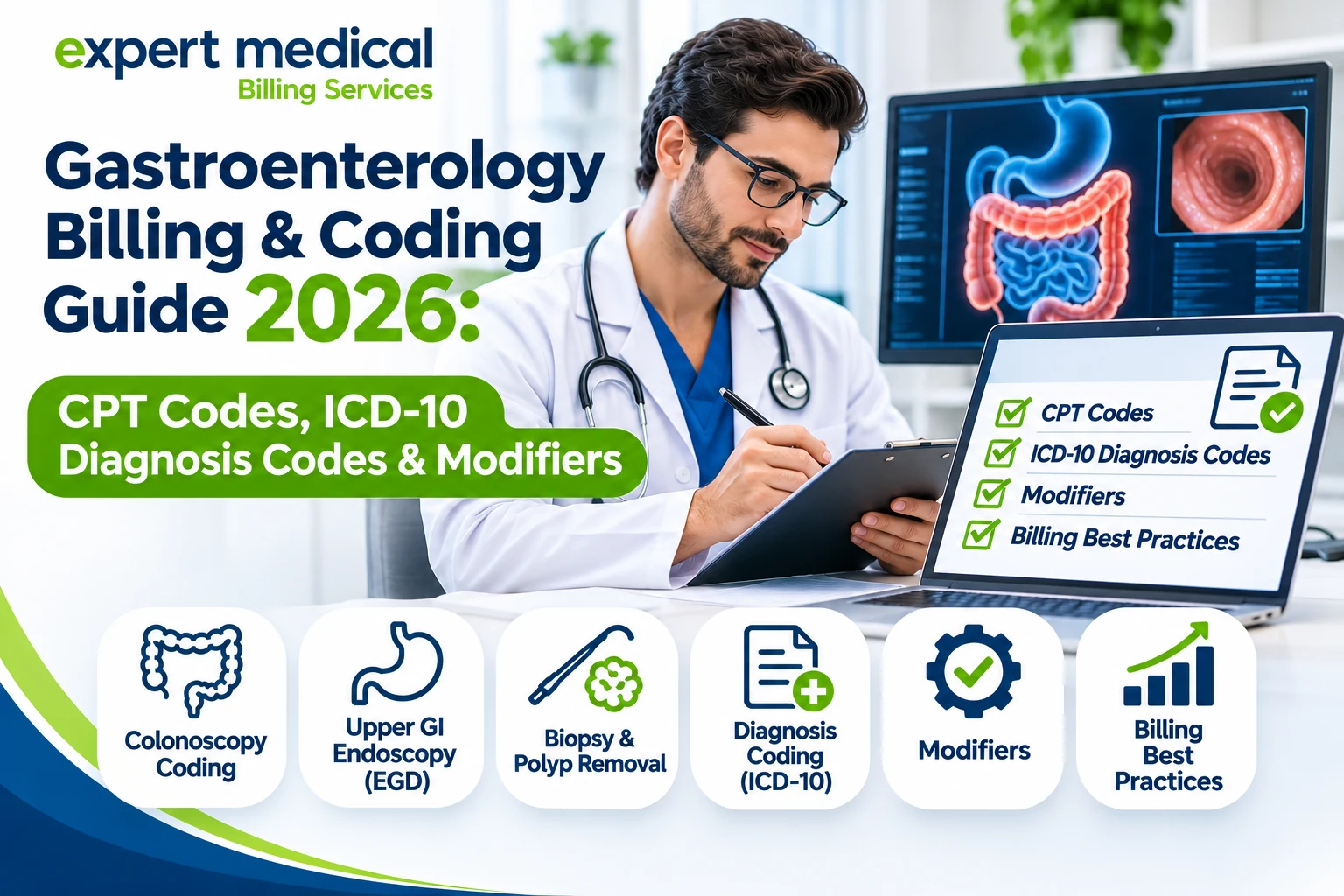
Gastroenterology is a specialty that involves a wide range of diagnostic and therapeutic services, from routine office visits and preventive screenings to colonoscopies, upper gastrointestinal endoscopies, biopsies, polyp removal, and other specialized procedures.
With so many different services involved, gastroenterology billing requires careful attention to coding and documentation. Selecting the wrong CPT code, using an unsupported modifier, reporting an inaccurate diagnosis, or overlooking a payer requirement can result in claim rejections, denials, payment delays, and unnecessary administrative work.
What Is Gastroenterology Medical Billing?
Gastroenterology medical billing is the process of converting the healthcare services provided by a gastroenterology practice into properly coded and submitted claims.
A typical billing process may include:
- Patient registration
- Insurance eligibility verification
- Benefits verification
- Authorization when required
- Clinical documentation
- CPT/HCPCS code selection
- ICD-10-CM diagnosis coding
- Modifier review
- Claim submission
- Payment posting
- Denial management
- Accounts receivable follow-up
Every step contributes to the financial health of the practice.
For example, if a patient has an insurance authorization requirement and the practice doesn’t obtain it before the procedure, the resulting claim could face a preventable denial.
Similarly, if the procedure documentation supports one service but the claim reports another, the payer may question or deny the claim.
That is why gastroenterology billing needs both coding accuracy and a consistent billing workflow.
CPT vs. ICD-10-CM vs. Modifiers
Before looking at specific gastroenterology codes, it helps to understand what each coding system does.
CPT Codes
CPT codes describe medical procedures and professional services performed by healthcare providers.
In gastroenterology, CPT codes may be used for services such as:
- Colonoscopy
- Upper GI endoscopy
- Biopsy
- Polyp removal
- Injection procedures
- Hemorrhage control
- Dilation
- Certain advanced endoscopic procedures
ICD-10-CM Diagnosis Codes
ICD-10-CM codes describe the patient’s diagnosis, condition, symptom, or reason for receiving a service.
For example, a patient may have a documented history of gastrointestinal symptoms, an abnormal finding, reflux disease, inflammatory bowel disease, or another condition.
The diagnosis code should accurately reflect the patient’s medical record.
Modifiers
Modifiers provide additional information about a reported service when the circumstances meet the applicable requirements.
They may communicate information about:
- Separate services
- Professional or technical components
- Reduced services
- Discontinued procedures
- Specific Medicare circumstances
- Other circumstances recognized by coding and payer rules
A modifier should never be added simply because a provider wants a higher payment.
Common Gastroenterology CPT Codes
Gastroenterology involves many different procedures, so CPT selection depends on exactly what was performed and documented.
Below are examples of commonly encountered codes.
Colonoscopy CPT Codes
Colonoscopy is one of the most frequently billed procedures in gastroenterology.
Some commonly encountered codes include:
| CPT Code | General Service Description |
| 45378 | Diagnostic colonoscopy |
| 45379 | Colonoscopy with removal of foreign body |
| 45380 | Colonoscopy with biopsy |
| 45381 | Colonoscopy with submucosal injection |
| 45382 | Colonoscopy with control of bleeding |
| 45384 | Colonoscopy with removal of tumor/polyp by hot biopsy forceps |
| 45385 | Colonoscopy with removal of tumor/polyp by snare |
| 45388 | Colonoscopy with ablation of tumor, polyp, or other lesion |
The correct code should be based on the actual procedure documented in the operative or procedure report.
A colonoscopy that includes a biopsy, for example, should not automatically be reported using only the diagnostic colonoscopy code when the documentation supports a separately reportable procedure.
Upper GI Endoscopy CPT Codes
Upper gastrointestinal endoscopy, commonly referred to as EGD, is another major area of gastroenterology billing.
Commonly encountered codes include:
| CPT Code | General Service Description |
| 43235 | Diagnostic upper GI endoscopy |
| 43239 | Upper GI endoscopy with biopsy |
| 43242 | Upper GI endoscopy with certain EUS-guided sampling |
| 43243 | Upper GI endoscopy with injection procedure |
| 43244 | Upper GI endoscopy with band ligation |
| 43245 | Upper GI endoscopy with dilation |
| 43246 | Upper GI endoscopy with gastrostomy tube placement |
| 43247 | Upper GI endoscopy with foreign body removal |
| 43248 | Upper GI endoscopy with dilation over guide wire |
| 43249 | Upper GI endoscopy with balloon dilation |
| 43251 | Upper GI endoscopy with removal of tumor/polyp |
| 43255 | Upper GI endoscopy with control of bleeding |
These are examples of commonly encountered gastroenterology procedure codes and should not be treated as a complete coding list.
Always verify the current code descriptor and reporting requirements before submitting a claim.
Other Gastroenterology Procedures
Depending on the scope of a practice, gastroenterology billing may also involve:
Endoscopic Ultrasound
Endoscopic ultrasound can be used to evaluate structures within and around the gastrointestinal tract and, in appropriate circumstances, obtain tissue samples.
ERCP
Endoscopic retrograde cholangiopancreatography is a specialized procedure used for certain biliary and pancreatic conditions.
Capsule Endoscopy
Capsule endoscopy allows visualization of portions of the gastrointestinal tract using a small ingestible camera.
Liver-Related Procedures
Some gastroenterology practices also perform or manage liver-related procedures and services, depending on their specialty scope.
The important principle is that the procedure code should reflect the service actually performed and documented.
Common Gastroenterology ICD-10-CM Diagnosis Codes
Diagnosis coding is just as important as procedure coding.
The diagnosis should explain the patient’s documented condition or the reason for the service.
Common gastroenterology diagnosis categories include the following.
Gastroesophageal Reflux Disease
GERD is frequently encountered in gastroenterology practices.
The appropriate ICD-10-CM code should be selected based on the documented diagnosis and applicable coding guidance.
Dysphagia
Patients may be evaluated for difficulty swallowing.
The specific diagnosis should reflect the documentation and type of dysphagia when sufficient information is available.
Abdominal Pain
Abdominal pain can be associated with many different conditions.
When a definitive diagnosis has not been established, the appropriate symptom code may be reported according to applicable coding guidelines.
Gastrointestinal Bleeding
GI bleeding can involve different anatomical locations and clinical circumstances.
The diagnosis code should accurately reflect the documented type and source when known.
Gastritis
Gastritis can have different classifications and characteristics, so the diagnosis should be coded to the level of specificity supported by documentation.
Peptic Ulcer Disease
The appropriate diagnosis code can depend on the type and documented complications of the ulcer.
Crohn’s Disease
Crohn’s disease is an inflammatory bowel disease that can affect different parts of the digestive tract.
The appropriate ICD-10-CM code may depend on location and documented complications.
Ulcerative Colitis
Ulcerative colitis coding may also require attention to the affected site and whether complications are documented.
Irritable Bowel Syndrome
IBS may be coded according to the documented type and clinical presentation.
Diverticular Disease
The correct code may depend on whether complications such as bleeding or perforation are documented.
Hemorrhoids
Hemorrhoid coding depends on the documented type and characteristics.
Colon Polyps
Diagnosis coding for polyps should accurately reflect the condition documented in the medical record and applicable coding guidance.
Why Diagnosis Specificity Matters?
One of the most important principles in medical coding is specificity supported by documentation.
A coder should not automatically choose a broad or unspecified diagnosis when the medical record provides enough information to report a more specific condition.
At the same time, coders should not invent specificity that isn’t documented.
The goal is simple:
Code what is documented—accurately and appropriately.
Diagnosis coding should never be selected simply because a particular code is believed to produce better reimbursement.
Screening vs. Diagnostic Colonoscopy
This is one of the most important topics in gastroenterology billing.
A colonoscopy can be performed for different reasons.
Screening Colonoscopy
A screening colonoscopy is performed as a preventive service for an eligible patient who does not necessarily have symptoms requiring diagnostic investigation.
Diagnostic Colonoscopy
A diagnostic colonoscopy may be performed to investigate symptoms, abnormal findings, or known conditions.
When a Screening Procedure Becomes Diagnostic
Sometimes a procedure begins as a screening examination but a finding leads to additional diagnostic or therapeutic work.
For example, a physician may identify a polyp and remove it during the examination.
The resulting coding and billing treatment depends on the specific circumstances, documentation, payer, and applicable rules.
This is why practices should carefully distinguish the original indication from the services ultimately performed.
Gastroenterology Modifiers
Modifiers can be an important part of gastroenterology billing, particularly when multiple procedures or special circumstances are involved.
Some modifiers that may be encountered include:
| Modifier | General Purpose |
| 25 | Significant, separately identifiable E/M service when applicable |
| 26 | Professional component |
| 51 | Multiple procedures, when applicable |
| 52 | Reduced services |
| 53 | Discontinued procedure |
| 59 | Distinct procedural service |
| 73 | Certain discontinued outpatient/hospital procedures before anesthesia |
| 74 | Certain discontinued outpatient/hospital procedures after anesthesia or surgical preparation |
| PT | Certain Medicare colorectal cancer screening circumstances |
Modifier requirements can differ depending on the procedure and setting.
A modifier should be used only when the circumstances meet the applicable requirements.
Modifier 25 in Gastroenterology
Modifier 25 is often discussed when an evaluation and management service occurs on the same date as another procedure.
However, it should not automatically be added to every office visit performed on a procedure date.
The documentation needs to support a significant, separately identifiable E/M service that meets the applicable requirements.
For example, if the physician performs a procedure and also provides a separate evaluation addressing an unrelated or additional problem, modifier 25 may be appropriate when the documentation supports it.
The exact circumstances should always be evaluated using current coding and payer guidance.
Modifier 59 in Gastroenterology
Modifier 59 is used to identify a distinct procedural service when the applicable criteria are met.
It may be relevant in circumstances involving:
- Different encounters
- Different procedures
- Different anatomical sites
- Separate lesions
- Other qualifying circumstances
Modifier 59 should not be used simply to bypass an NCCI edit or force additional payment.
The documentation must support the distinct nature of the services.
Modifier PT and Colorectal Cancer Screening
Modifier PT is particularly relevant to certain Medicare colorectal cancer screening situations.
A screening colonoscopy can sometimes result in a diagnostic or therapeutic service being performed because a finding is identified.
The appropriate reporting depends on the circumstances and current Medicare rules.
Because screening and diagnostic services can have different coverage and cost-sharing implications, practices should review the applicable CMS guidance when reporting these claims.
Documentation Requirements for Gastroenterology Billing
Strong documentation is essential for accurate coding.
Depending on the service, the medical record may need to support:
- Reason for the procedure
- Patient history
- Symptoms
- Medical indication
- Pre-procedure assessment
- Procedure performed
- Anatomical location
- Findings
- Biopsies
- Polyp removal
- Injection
- Dilation
- Bleeding control
- Complications
- Post-procedure instructions
- Follow-up recommendations
The procedure report should clearly describe what happened.
For example, if a polyp was removed by snare, the documentation should support that service.
If a biopsy was performed, the documentation should support the biopsy.
Accurate documentation gives the coding team the information needed to select the appropriate code.
Common Gastroenterology Billing Mistakes
Even experienced practices can encounter billing problems.
Here are some common mistakes to watch for.
1. Incorrect CPT Selection
Reporting a code that doesn’t match the procedure performed can result in a claim issue.
2. Inaccurate Diagnosis Coding
The diagnosis should be supported by the patient’s medical record.
3. Unnecessary Modifiers
Modifiers should not be added simply to increase payment.
4. Missing Modifiers
When a modifier is required and supported by the circumstances, leaving it off can affect claim processing.
5. Confusing Screening and Diagnostic Services
The indication and services performed should be reviewed carefully.
6. Incomplete Procedure Documentation
If the procedure report doesn’t clearly describe what was performed, accurate coding becomes more difficult.
7. Incorrect Place of Service
The place of service reported on the claim should accurately reflect where the service was performed.
8. Missing Authorization
Some procedures may require prior authorization depending on the payer and patient’s plan.
9. Eligibility Problems
Patient insurance information can change, making eligibility verification important.
10. Failure to Monitor Denials
Repeated denials can indicate an underlying process problem that needs attention.
Common Gastroenterology Claim Denials
Gastroenterology practices may encounter denials related to:
- Incorrect CPT codes
- Diagnosis-code issues
- Modifier errors
- Medical necessity
- Eligibility
- Authorization
- Duplicate claims
- Bundling edits
- Incorrect place of service
- Documentation
- Non-covered services
- Timely filing
A denial should not be treated as simply a billing team’s problem.
It can provide useful information about where the practice’s workflow may need improvement.
For example, if the same authorization denial occurs repeatedly, the practice may need to review its pre-procedure verification process.
If modifier-related denials keep appearing, the coding workflow may need additional review.
How to Reduce Gastroenterology Billing Denials
A proactive billing process can prevent many avoidable errors.
Verify Insurance
Check eligibility and benefits before providing services whenever appropriate.
Review Authorization Requirements
Confirm whether the patient’s plan requires authorization for the planned service.
Verify the Procedure Documentation
Make sure the documentation clearly supports the services performed.
Review CPT Codes
Confirm that the procedure code accurately reflects the service.
Review ICD-10-CM Codes
Make sure the diagnosis supports the documented reason for the service.
Check Modifiers
Use modifiers only when applicable and supported.
Submit Clean Claims
Review patient information, payer details, codes, modifiers, and other claim elements before submission.
Track Denials
Look for patterns instead of treating every denial as an isolated event.
Follow Up on A/R
Unpaid claims should be monitored and worked consistently.
Gastroenterology Reimbursement: What Providers Should Know
Many practice owners search for specific reimbursement rates for gastroenterology CPT codes.
However, there is no single payment amount that applies to every provider.
Reimbursement can vary depending on:
- Payer
- Medicare locality
- Geographic location
- Provider contract
- Place of service
- Facility vs. professional billing
- Patient insurance plan
- Procedure
- Modifier
- Multiple-procedure circumstances
For example, a Medicare payment amount for a particular procedure may differ from a commercial payer’s contracted amount.
Likewise, a commercial payer may have different reimbursement arrangements for different providers or plans.
This is why practices should compare payments against current payer contracts, fee schedules, remittance information, and applicable payment rules rather than relying on generic online rate lists.
How to Monitor Gastroenterology Underpayments
Payment monitoring can help identify potential revenue leakage.
A practice can establish an expected reimbursement amount based on its applicable payer agreement or payment methodology.
Then it can compare the expected amount with the actual payment.
For example:
Expected payment: $300
Actual payment: $250
Difference: $50
This $50 difference is not automatically an underpayment. The practice should first review contractual adjustments, patient responsibility, payer policies, and the explanation of payment.
If the payment still doesn’t appear correct, the billing team can investigate further.
Regular payment reviews can help practices identify recurring payer discrepancies.
Gastroenterology Billing Checklist
A simple checklist can help create a more consistent workflow.
Before the Procedure
☐ Verify patient demographics
☐ Verify insurance eligibility
☐ Check benefits
☐ Confirm authorization when required
☐ Confirm provider participation
During and After the Procedure
☐ Document the indication
☐ Document findings
☐ Record the procedure performed
☐ Document biopsies or polyp removal
☐ Record other therapeutic services
☐ Document complications when applicable
Before Claim Submission
☐ Select the appropriate CPT code
☐ Select appropriate ICD-10-CM diagnosis codes
☐ Review modifiers
☐ Verify place of service
☐ Check payer-specific requirements
☐ Review the claim for errors
After Submission
☐ Monitor claim status
☐ Review EOBs and ERAs
☐ Post payments correctly
☐ Investigate denials
☐ Follow up on unpaid claims
☐ Monitor A/R aging
How EMBS Can Help Gastroenterology Practices
Gastroenterology practices have enough to manage without spending countless hours dealing with unpaid claims and billing problems.
From eligibility verification to denial follow-up, a well-organized revenue cycle can make the administrative side of the practice much easier to manage.
At Expert Medical Billing Services (EMBS), we support healthcare providers with services designed to improve billing workflow and revenue cycle management.
Our services include:
- Medical Billing
- Insurance Verification
- Claims Processing
- Denial Management
- Accounts Receivable Follow-Up
- Credentialing
- Revenue Cycle Management
- Payment Posting
Our focus is on helping healthcare providers maintain accurate, organized, and consistent billing processes.
That means less time spent chasing billing issues and more time available for patient care.
Conclusion
Gastroenterology billing requires attention to detail at every stage of the revenue cycle. From selecting the appropriate CPT code and ICD-10-CM diagnosis to reviewing documentation and applying modifiers correctly, each part of the process contributes to accurate claim submission.
Colonoscopy, EGD, biopsies, polyp removal, screening procedures, and other gastroenterology services can have different coding and billing requirements. At the same time, Medicare, Medicaid, and commercial payers may apply different coverage, authorization, and reimbursement rules.
The goal should never be to simply submit more claims. The goal is to submit accurate, well-supported claims and maintain a consistent process for tracking payments, correcting errors, and resolving denials.
At EMBS, we help healthcare providers manage the administrative side of medical billing through organized billing, insurance verification, denial management, credentialing, A/R follow-up, and revenue cycle support.You focus on caring for your patients. Let EMBS help you stay focused on your revenue cycle.