
Introduction
Submitting medical claims is an essential part of keeping a healthcare practice financially healthy. However, not every claim moves smoothly through the billing process. Some claims encounter errors during electronic submission and are returned before the insurance company can process them. These errors are commonly known as clearinghouse rejections.
Clearinghouse rejection codes help medical billing professionals understand why a claim could not pass the initial submission requirements. They may indicate incorrect patient information, missing provider details, invalid codes, incomplete claim fields, or problems with electronic claim formatting.
Although a rejected claim may seem like a small administrative issue, repeated rejections can create significant problems for healthcare practices. They increase staff workload, delay reimbursement, interrupt cash flow, and create additional pressure on billing departments.
Understanding clearinghouse rejection codes allows billing teams to identify problems early, correct inaccurate information, and resubmit claims without unnecessary delays.
In this guide, we will explore what clearinghouse rejection codes mean, the most common reasons claims are rejected, how to correct these errors, and practical ways healthcare providers can reduce future rejections.
1. What Are Clearinghouse Rejection Codes in Medical Billing?
Clearinghouse rejection codes are error indicators or messages generated when an electronic medical claim fails certain validation requirements during the submission process.
A medical billing clearinghouse acts as an intermediary between healthcare providers and insurance companies. Before forwarding a claim to the appropriate payer, the clearinghouse checks whether the submitted information meets the required electronic formatting and data standards.
If something is missing, incorrect, or improperly formatted, the claim may be rejected. The clearinghouse then returns an error message explaining what needs attention.
For example, a claim may be rejected because the patient’s insurance identification number is invalid, the billing provider’s National Provider Identifier (NPI) is missing, or a required data element has not been completed.
These rejection messages help billing professionals identify the source of the problem instead of repeatedly submitting claims with the same errors.
Why are clearinghouse rejection codes important?
- They help identify errors before payer adjudication.
- They reduce unnecessary claim processing delays.
- They help billing teams correct incomplete information.
- They support cleaner electronic claim submissions.
- They improve communication between providers, clearinghouses, and payers.
- They help practices maintain a more organized revenue cycle.
Understanding these messages is an important step toward improving claim accuracy and maintaining consistent reimbursement.
2. What Is a Medical Billing Clearinghouse?
A medical billing clearinghouse is an electronic service that receives healthcare claims from providers, checks them for submission errors, and forwards them to the appropriate insurance companies.
Instead of sending electronic claims individually to multiple payers, healthcare practices can use a clearinghouse to simplify the submission process.
The clearinghouse performs several important functions:
Claim receiving: It receives electronic claims from the provider’s billing software or practice management system.
Data validation: It checks submitted information for missing fields, formatting problems, and other claim-related errors.
Claim routing: It identifies the appropriate payer and routes the claim through the correct electronic submission channel.
Rejection reporting: If a claim fails validation, the clearinghouse sends an error report explaining the problem.
Submission tracking: It helps billing teams monitor claim acknowledgments and identify whether claims have moved successfully through the submission process.
A clearinghouse does not guarantee payment or determine whether a medical service is covered. Its primary responsibility is to help claims meet the applicable electronic submission requirements before they proceed to the payer.
3. How Do Clearinghouse Rejection Codes Work?
Understanding the rejection process makes it easier for billing professionals to identify where an error occurred.
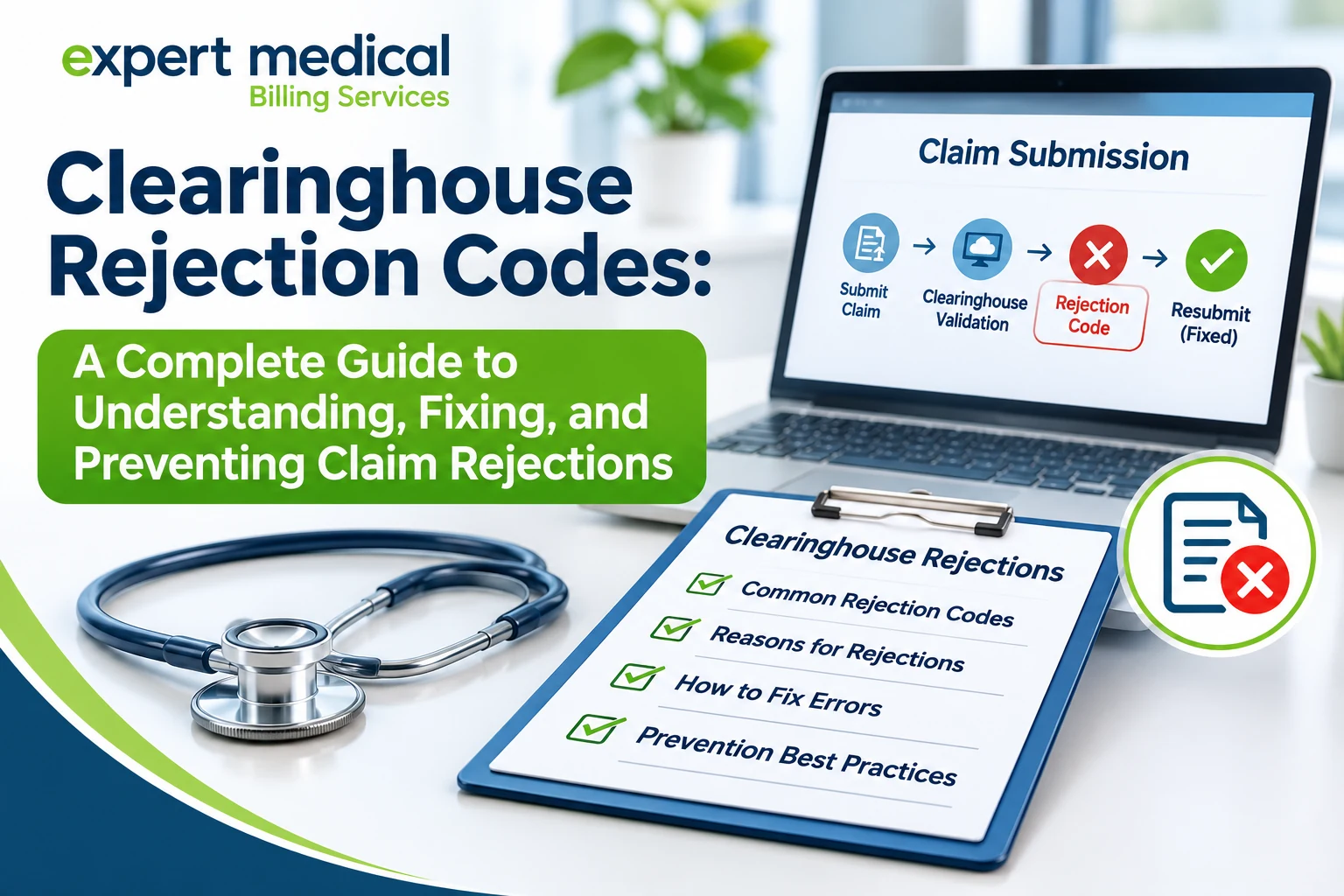
Here is how a typical electronic claim submission process works:
- Patient information is collected: The healthcare provider gathers demographic and insurance information during registration.
- Services are documented: The provider records the services performed, diagnoses, and other relevant clinical information.
- The claim is prepared: The billing team enters the necessary information, including procedure codes, diagnosis codes, modifiers, and provider details.
- The claim is submitted: The completed electronic claim is transmitted to the clearinghouse.
- The clearinghouse validates the claim: The system checks the claim against applicable electronic submission requirements.
- An error is identified: If the claim fails validation, the clearinghouse returns a rejection message.
- The billing team corrects the issue: Staff members investigate the error, update the necessary information, and validate the claim again.
- The corrected claim is resubmitted: The claim is transmitted again through the appropriate submission channel.
It is important to understand that a clearinghouse rejection does not automatically mean the insurance company has denied the service. In many cases, the claim has not yet reached the payer for adjudication.
4. Common Clearinghouse Rejection Codes and Their Meanings
One of the biggest challenges in medical billing is understanding the different rejection messages returned during electronic claim submission. Each rejection points toward a specific problem that needs investigation.
It is important to remember that clearinghouses do not all use one universal list of rejection code numbers. The exact code, description, and correction process may vary depending on the clearinghouse, payer, and electronic transaction requirements.
Below are some common rejection categories that medical billing professionals encounter.
4.1 Invalid Member ID
An invalid member ID rejection occurs when the patient’s insurance identification number is incorrect, incomplete, or does not match the payer’s records.
Common causes:
- Incorrect member ID entered during registration.
- Missing letters or numbers.
- Outdated insurance information.
- Incorrect insurance plan selected.
- Patient information does not match the insurance record.
How to fix it:
Review the patient’s insurance card and verify the identification number. Confirm the correct insurance plan and update the patient’s information in the billing system before resubmitting the claim.
4.2 Invalid Patient Information
Patient demographic errors can prevent claims from passing clearinghouse validation.
These errors may involve the patient’s name, date of birth, gender information, or other required demographic fields.
Common causes:
- Misspelled patient name.
- Incorrect date of birth.
- Missing demographic information.
- Differences between registration records and payer records.
- Incorrect patient relationship information.
How to fix it:
Compare the claim information with the patient’s registration documents and insurance records. Correct the inaccurate details and ensure that the information matches the applicable payer requirements.
4.3 Missing or Invalid Provider NPI
A National Provider Identifier (NPI) is a unique identification number assigned to healthcare providers.
Claims may be rejected when the billing provider’s or rendering provider’s NPI is missing, incorrectly entered, or reported in an inappropriate location.
Common causes:
- Incorrect NPI entered into the billing system.
- Missing rendering provider information.
- Incorrect billing provider details.
- Mismatch between provider information and enrollment records.
How to fix it:
Verify the provider’s NPI through the official NPPES NPI Registry. Review the billing and rendering provider information and make sure the correct identifiers are included in the appropriate claim fields.
4.4 Invalid Tax Identification Number
A Tax Identification Number (TIN) identifies the business or individual responsible for receiving payments and reporting tax information.
A claim may encounter an error when the submitted tax identification information does not match the applicable payer or provider records.
Common causes:
- Incorrect tax identification number.
- Outdated billing information.
- Mismatch between the provider’s TIN and enrollment records.
- Incorrect billing entity selected.
How to fix it:
Confirm the correct TIN with the provider’s official business and enrollment records. Check the billing provider information and verify that it matches the payer’s requirements.
4.5 Invalid Diagnosis Code
Diagnosis codes explain the patient’s medical condition and support the services reported on a claim.
An invalid diagnosis code rejection may occur when the submitted ICD-10-CM code is incomplete, outdated, incorrectly formatted, or not accepted under the applicable submission requirements.
Common causes:
- Incorrect ICD-10-CM code selection.
- Missing characters.
- Outdated code set.
- Improper code formatting.
- Missing required diagnosis information.
How to fix it:
Review the medical documentation and confirm the correct diagnosis code using the applicable ICD-10-CM guidelines. Check code validity for the date of service and ensure the diagnosis is reported accurately.
4.6 Invalid CPT or HCPCS Code
CPT and HCPCS codes describe the medical procedures, treatments, and services provided to patients.
Claims may be rejected when a procedure code is invalid for the applicable date of service or does not meet the required electronic claim submission rules.
Common causes:
- Incorrect procedure code.
- Outdated code selection.
- Missing characters or incorrect formatting.
- Incorrect code set for the service.
- Missing required claim information.
How to fix it:
Review the provider’s documentation and verify the applicable CPT or HCPCS code. Confirm that the code is valid for the date of service and meets the relevant payer and coding requirements.
4.7 Missing or Invalid Modifier
Modifiers provide additional information about a medical procedure or service without changing the basic meaning of the procedure code.
A claim may encounter an error when a required modifier is missing, incorrectly reported, or does not meet the applicable billing requirements.
Common causes:
- Missing required modifier.
- Incorrect modifier selection.
- Improper modifier placement.
- Inconsistent coding information.
- Failure to follow payer-specific instructions.
How to fix it:
Review the medical documentation and determine whether a modifier is required. Verify the correct modifier and its placement according to current coding guidelines and payer policies before resubmitting.
4.8 Invalid Place of Service Code
Place of Service (POS) codes identify the location where a healthcare service was provided.
An incorrect POS code may cause a claim to fail validation or encounter additional processing issues.
Common causes:
- Incorrect POS selection.
- Missing place of service information.
- Mismatch between the service location and submitted information.
- Incorrect setup in the billing software.
How to fix it:
Confirm where the service was actually performed and select the appropriate POS code. Review the applicable CMS and payer guidelines to ensure accurate reporting.
4.9 Missing Authorization Number
Some medical services require prior authorization from the insurance company before treatment is provided.
When authorization information is required but missing from the claim, the submission may encounter a rejection or another payer processing issue.
Common causes:
- Authorization number not entered.
- Incorrect authorization details.
- Expired authorization.
- Authorization linked to the wrong service.
- Missing required referral information.
How to fix it:
Review the authorization approval and confirm that it applies to the correct patient, provider, service, and date range. Enter the required information in the appropriate claim field.
4.10 Duplicate Claim Rejection
A duplicate claim rejection occurs when a submission appears to match a claim that has already been received or processed.
Common causes:
- Accidentally submitting the same claim twice.
- Resending a claim without checking its previous status.
- Duplicate entries in billing software.
- Incorrect claim frequency information.
How to fix it:
Check the original submission and acknowledgment reports before taking action. Determine whether the claim was accepted, rejected, or already processed. If a correction is necessary, follow the appropriate corrected-claim or resubmission requirements rather than simply sending the same claim again.
4.11 Invalid Payer ID
A payer ID is used to identify the insurance company or destination for electronic claim routing.
If the wrong payer ID is selected, the clearinghouse may be unable to route the claim correctly.
Common causes:
- Incorrect payer selected.
- Outdated payer information.
- Similar names associated with different insurance plans.
- Incorrect payer ID configured in billing software.
How to fix it:
Verify the payer ID through the clearinghouse’s current payer list or payer-specific instructions. Confirm that the selected destination matches the patient’s actual insurance plan.
4.12 Missing Required Claim Information
Medical claims contain several required data elements. If important information is missing or incomplete, the claim may fail electronic validation.
Common causes:
- Missing service dates.
- Incomplete provider information.
- Missing diagnosis details.
- Incomplete subscriber information.
- Missing required billing data.
How to fix it:
Review the rejection report carefully and identify the missing information. Compare the submitted claim with the applicable electronic claim requirements, update the incomplete fields, and validate the claim before resubmission.
5. Difference Between Clearinghouse Rejections and Insurance Denials
Claim rejections and insurance denials are often confused because both can interrupt the reimbursement process. However, they happen at different stages of medical billing and require different corrective actions.
A clearinghouse rejection generally occurs when a claim fails an initial electronic submission or validation requirement. An insurance denial occurs when a payer processes a claim and determines that payment cannot be made under the applicable coverage, coding, or payment rules.
Understanding this difference helps billing professionals select the correct resolution process.
| Comparison | Clearinghouse rejection | Insurance denial |
| Processing stage | During electronic submission or front-end validation | During or after payer adjudication |
| Main reason | Missing, invalid, or incorrectly formatted information | Coverage, medical necessity, coding, or policy issues |
| Typical response | Rejection report or acknowledgment | EOB or ERA with adjustment information |
| Corrective action | Correct the submission error and retransmit | Correct, appeal, or request reconsideration when appropriate |
| Payment status | Claim may not have entered payer adjudication | Payer has made a payment determination |
Example:
Imagine a healthcare provider submits a claim with an incorrect patient insurance ID. The clearinghouse identifies the problem and returns the claim with an error message. This is a clearinghouse rejection.
Now imagine the claim successfully reaches the insurance company, but the payer determines that the service does not meet its medical necessity requirements. The payer issues a denial. This is an insurance denial.
The difference is important because a rejected claim usually needs to be corrected and successfully transmitted, while a denied claim may require additional documentation, a corrected claim, or an appeal depending on the denial reason.
6. Why Do Medical Claims Get Rejected by Clearinghouses?
There is rarely just one reason behind claim rejections. In many practices, repeated errors result from gaps in patient registration, provider information, coding accuracy, or the claim submission process.
Here are some of the most common contributing factors.
1. Incorrect patient registration: Errors entered during registration can follow the claim throughout the billing process. Incorrect names, dates of birth, and insurance details can trigger validation problems.
2. Incomplete insurance verification: When eligibility and insurance information are not checked properly, billing teams may submit claims with outdated or inaccurate coverage details.
3. Provider information errors: Missing or incorrect NPI and TIN information can create problems with billing provider identification.
4. Coding inaccuracies: Incorrect diagnosis codes, procedure codes, and modifiers may prevent claims from meeting applicable submission requirements.
5. Lack of payer-specific knowledge: Insurance companies can have different claim submission requirements. Using the same billing approach for every payer may lead to avoidable errors.
6. Software configuration issues: Incorrect billing system settings, outdated payer information, and mapping problems can affect multiple claims.
7. Limited claim review: When claims are submitted without proper validation, small errors can easily pass through internal billing workflows.
Identifying the root cause of these issues is more effective than repeatedly correcting individual claims without addressing the underlying problem.
7. How to Fix Common Clearinghouse Rejection Errors
Correcting rejected claims requires more than changing a single field. Billing professionals should investigate the actual rejection message and understand why the claim failed.
The following approach can help create a more organized correction process.
| Rejection problem | Recommended corrective action |
| Invalid patient ID | Verify the member ID and insurance information. |
| Incorrect patient demographics | Compare the claim with registration and payer records. |
| Missing NPI | Verify billing and rendering provider identifiers. |
| Incorrect TIN | Confirm the billing entity’s tax information. |
| Invalid diagnosis code | Review documentation and applicable ICD-10-CM guidelines. |
| Invalid CPT/HCPCS code | Verify the code and date-of-service validity. |
| Missing modifier | Review documentation and applicable coding requirements. |
| Incorrect POS | Confirm the actual service location. |
| Missing authorization | Verify approval details and enter required information. |
| Duplicate claim | Check the original claim status before resubmitting. |
| Incorrect payer ID | Confirm the appropriate payer routing information. |
| Missing claim data | Review the rejection message and complete the required fields. |
A practical example of correcting a rejected claim
Suppose a physical therapy practice submits an electronic claim for a patient, but the clearinghouse returns an error indicating that the billing provider information is incomplete.
Instead of immediately resubmitting the same claim, the billing specialist should:
Open the clearinghouse rejection report.
Identify the exact provider information causing the error.
Review the billing provider’s NPI and other required details.
Compare the information with the billing system and payer enrollment records.
Correct the inaccurate or missing information.
Run the claim through validation again.
Resubmit the corrected claim.
Review the new acknowledgment to confirm its status.
This approach helps resolve the actual issue and reduces the possibility of receiving the same rejection again.
8. Step-by-Step Process for Managing Clearinghouse Rejections
An effective rejection management process helps healthcare practices resolve errors quickly and avoid unnecessary delays. Billing teams should follow a consistent workflow so that every rejected claim receives proper attention.
Step 1: Monitor Claim Acknowledgment Reports
After submitting electronic claims, regularly review the acknowledgment reports provided by the clearinghouse or payer. These reports help identify which submissions were accepted and which require correction.
Step 2: Identify the Rejection Reason
Read the rejection message carefully. Do not rely only on the short description. Review the associated error information to understand which claim field or requirement caused the problem.
Step 3: Investigate the Root Cause
Check the patient’s demographic information, insurance details, provider credentials, coding information, and other relevant claim fields.
The goal is to determine why the error occurred rather than simply making a temporary adjustment.
Step 4: Correct the Claim Information
Update the incorrect or missing information based on the rejection details. Make sure any correction is supported by the medical record, registration information, or appropriate payer documentation.
Step 5: Perform Claim Validation
Before resubmitting, review the entire claim to make sure the original issue has been resolved and no additional errors have been introduced.
Step 6: Resubmit the Corrected Claim
Transmit the corrected claim through the appropriate clearinghouse or payer channel. Follow the applicable submission instructions and corrected-claim requirements.
Step 7: Track the New Claim Status
Review the subsequent acknowledgment and monitor the claim until its status is clear. A successful electronic acknowledgment does not necessarily mean that the claim has been approved for payment.
Following these steps helps billing teams maintain better control over rejected claims and reduce repeated submission problems.
9. How to Prevent Clearinghouse Claim Rejections
Preventing rejections is more efficient than repeatedly correcting claims after submission. Healthcare practices can reduce avoidable errors by improving their internal billing procedures and introducing stronger quality checks.
Here are some practical strategies.
1. Verify Patient Eligibility Before Appointments
Check the patient’s insurance eligibility and coverage information before services are provided. Confirm the member ID, plan details, and other required information.
2. Maintain Accurate Patient Demographics
Make sure patient names, dates of birth, and other demographic details are entered correctly. Even minor registration mistakes can create problems during claim submission.
3. Keep Provider Information Updated
Regularly review NPI, TIN, billing provider, rendering provider, and enrollment information. Accurate provider records help prevent identification and routing issues.
4. Review CPT and ICD-10-CM Codes
Ensure that procedure and diagnosis codes are selected correctly according to the medical documentation and applicable coding guidelines.
5. Check Modifiers Carefully
Review whether modifiers are required and confirm that they are supported by the documentation and applicable payer policies.
6. Confirm Authorization Requirements
Check whether a service requires prior authorization or a referral. Make sure the approval details match the patient, service, provider, and applicable dates.
7. Use Automated Claim Scrubbing
Claim-scrubbing tools can identify many missing fields, invalid code combinations, and formatting problems before electronic submission.
8. Train Medical Billing Staff
Provide regular training on coding updates, payer-specific requirements, electronic claim standards, and rejection resolution procedures.
9. Review Rejection Trends
Analyze rejection reports to identify recurring problems. If multiple claims are rejected for the same reason, investigate whether the issue comes from staff procedures, software configuration, or incorrect data.
10. Establish a Consistent Follow-Up Process
Assign responsibility for monitoring rejected claims and make sure corrections are completed promptly. Maintain a record of the original rejection, corrective action, and subsequent claim status.
10. The Role of Technology in Reducing Claim Rejections
Technology has become an important part of modern medical billing. Healthcare practices increasingly rely on electronic tools to improve claim accuracy, reduce manual work, and identify submission problems before claims reach the payer.
Some useful technologies include:
Automated Claim Scrubbing
Claim-scrubbing software checks submitted information against configured billing rules and identifies potential errors before claims are transmitted.
Real-Time Eligibility Verification
Electronic eligibility tools help billing teams confirm patient coverage and insurance details. This can reduce errors associated with outdated or incorrect insurance information.
Electronic Claim Validation
Validation systems review electronic claim data to identify missing information, incorrect formatting, and other submission issues.
Automated Rejection Alerts
Automated notifications help billing professionals identify rejected claims without manually checking every submission.
Billing Software Integration
Integrated practice management and billing systems can help maintain consistent patient, provider, and insurance information across different stages of the revenue cycle.
Reporting and Performance Analytics
Reporting tools help practices understand rejection patterns, identify recurring errors, and evaluate the effectiveness of their billing procedures.
Although technology can improve efficiency, it cannot replace professional review. Accurate documentation, correct coding, and knowledgeable billing staff remain essential.
11. How Clearinghouse Rejections Affect Revenue Cycle Management
Clearinghouse rejections can create problems throughout the revenue cycle when they are not identified and resolved promptly.
Even a small submission error can lead to additional work for billing staff and delay the movement of a claim toward payment.
Here are some of the major effects.
Delayed Reimbursements
Rejected claims need to be corrected and transmitted again. This additional processing time can delay the reimbursement cycle.
Increased Accounts Receivable
When claims remain unresolved, the outstanding accounts receivable balance may increase. Billing teams must spend additional time identifying and correcting these claims.
Higher Administrative Costs
Repeated claim corrections require staff time and additional administrative resources. This can reduce the productivity of the billing department.
Increased Risk of Filing Deadline Issues
Repeated rejections can consume valuable time and increase the risk of missing payer timely filing deadlines. Practices should monitor the applicable filing limits and act promptly.
Disrupted Cash Flow
When a large number of claims experience submission problems, expected payments may be delayed, making financial planning more difficult for healthcare practices.
Reduced Operational Efficiency
Billing teams may spend more time correcting preventable errors instead of focusing on other important revenue cycle activities.
For these reasons, rejection management should be treated as an ongoing part of revenue cycle management rather than an occasional administrative task.
12. Understanding Important Electronic Claim Acknowledgment Transactions
Medical billing professionals should understand that not every rejection message comes in the same format. Different electronic acknowledgment transactions communicate different types of submission information.
Three important transactions include:
| Transaction | Purpose |
| TA1 | Reports interchange-level acknowledgment and certain structural errors. |
| 999 | Reports whether an electronic transaction meets applicable implementation and structural requirements. |
| 277CA | Provides claim-level acknowledgment information, including acceptance or rejection status. |
TA1 Interchange Acknowledgment: This transaction communicates whether the electronic interchange was received and identifies certain problems with its overall structure.
999 Implementation Acknowledgment: This report provides information about whether an electronic transaction meets the applicable implementation guide requirements. It may indicate acceptance, rejection, or acceptance with errors noted.
277CA Health Care Claim Acknowledgment: This transaction provides more specific information about individual claims within an electronic submission, including whether claims were accepted or rejected during the applicable front-end processing.
These acknowledgments help billing teams identify where a problem occurred and determine which corrective action is necessary.
For example, an issue with the overall electronic interchange may appear in a TA1 report, while an implementation-related issue may appear in a 999 report. Claim-level rejection information may be communicated through a 277CA.
It is important to review the complete acknowledgment information rather than relying on a single status message. An accepted 999 does not necessarily mean that every individual claim has passed claim-level validation or received payer approval.
13. How EMBS Helps Healthcare Providers Reduce Claim Rejections
Managing medical claims requires attention to detail, accurate information, and consistent follow-up. For many healthcare practices, handling these responsibilities internally can become challenging, especially when claim volumes increase.
Expert Medical Billing Services (EMBS) helps healthcare providers strengthen their billing operations through professional medical billing and revenue cycle management support.
Our services focus on improving claim accuracy, identifying billing issues, and supporting a more organized reimbursement process.
Accurate Medical Coding: Our team focuses on accurate coding practices to help reduce avoidable errors related to diagnosis codes, procedure codes, and modifiers.
Claim Submission and Scrubbing: We support proper claim preparation and review to identify potential submission issues before claims are transmitted.
Insurance Eligibility Verification: Accurate insurance information helps reduce registration-related billing problems and unnecessary claim rework.
Clearinghouse Rejection Management: We help identify rejection reasons, investigate claim errors, make appropriate corrections, and manage resubmissions.
Denial Management: Our team supports the review and resolution of insurance denials through appropriate corrective actions and follow-up.
Accounts Receivable Management: Consistent A/R follow-up helps practices monitor outstanding claims and identify reimbursement delays.
Revenue Cycle Management: We support different stages of the billing process to help healthcare providers improve operational efficiency and maintain better control over their revenue cycle.
At EMBS, our goal is to help healthcare providers spend less time dealing with billing complications and more time focusing on patient care.
14. Frequently Asked Questions About Clearinghouse Rejection Codes
1. What are clearinghouse rejection codes in medical billing?
Clearinghouse rejection codes are error indicators or messages that explain why an electronic medical claim failed a submission or validation requirement. They help billing professionals identify missing, incorrect, or improperly formatted information.
2. Why do medical claims get rejected by clearinghouses?
Medical claims may be rejected because of incorrect patient information, invalid insurance IDs, missing provider details, incorrect payer IDs, coding errors, incomplete claim fields, or electronic formatting problems.
3. What is the difference between a claim rejection and a denial?
A rejection generally occurs before or during initial claim acceptance and validation. A denial occurs when the insurance payer processes the claim and determines that payment cannot be made under the applicable rules or policies.
4. How can medical billers identify clearinghouse rejection codes?
Medical billers can identify rejection information by reviewing clearinghouse reports, electronic acknowledgment transactions, and claim status messages. They should examine the complete error description to determine the actual problem.
5. Can a rejected medical claim be resubmitted?
Yes. Most correctable rejected claims can be corrected and resubmitted. However, billing professionals should first determine the reason for rejection and follow the appropriate submission instructions.
6. How long does it take to correct a rejected claim?
The time required depends on the type of error, the availability of accurate information, and the clearinghouse or payer’s processing procedures. Simple demographic corrections may be completed quickly, while provider enrollment or authorization issues may require additional investigation.
7. What happens if a rejected claim is not corrected?
An unresolved rejected claim may never proceed to payer adjudication. This can delay reimbursement, increase outstanding accounts receivable, and create a risk of missing timely filing deadlines.
8. How can clearinghouse rejections be prevented?
Healthcare practices can reduce rejections by verifying patient eligibility, maintaining accurate provider information, reviewing codes and modifiers, using claim-scrubbing tools, and monitoring payer-specific submission requirements.
9. What is the role of claim scrubbing in rejection prevention?
Claim scrubbing checks medical claims for potential errors before submission. It can identify missing information, invalid codes, and other issues that may prevent claims from passing initial validation.
10. Do clearinghouse rejection codes vary between clearinghouses?
Yes. Different clearinghouses and payers may use different internal error codes, descriptions, and validation rules. Standardized X12 acknowledgment transactions also contain defined code systems. Billing professionals should consult the relevant clearinghouse or payer documentation when interpreting a specific code.
Conclusion
Clearinghouse rejection codes are an important part of the medical billing process because they help healthcare providers identify problems before claims move further through the reimbursement cycle.
From incorrect patient information and missing provider details to coding errors and incomplete claim submissions, even small mistakes can interrupt the billing workflow. However, with proper claim validation, accurate documentation, and consistent rejection monitoring, many avoidable submission problems can be reduced.
Healthcare practices should focus not only on correcting rejected claims but also on identifying the underlying reasons behind recurring errors. A proactive approach can help reduce administrative workload, improve claim submission accuracy, and support a healthier revenue cycle.
At Expert Medical Billing Services (EMBS), we believe that accurate billing is the foundation of stronger financial performance. Our team is committed to helping healthcare providers manage claims efficiently, address billing challenges, and improve their overall revenue cycle management.